

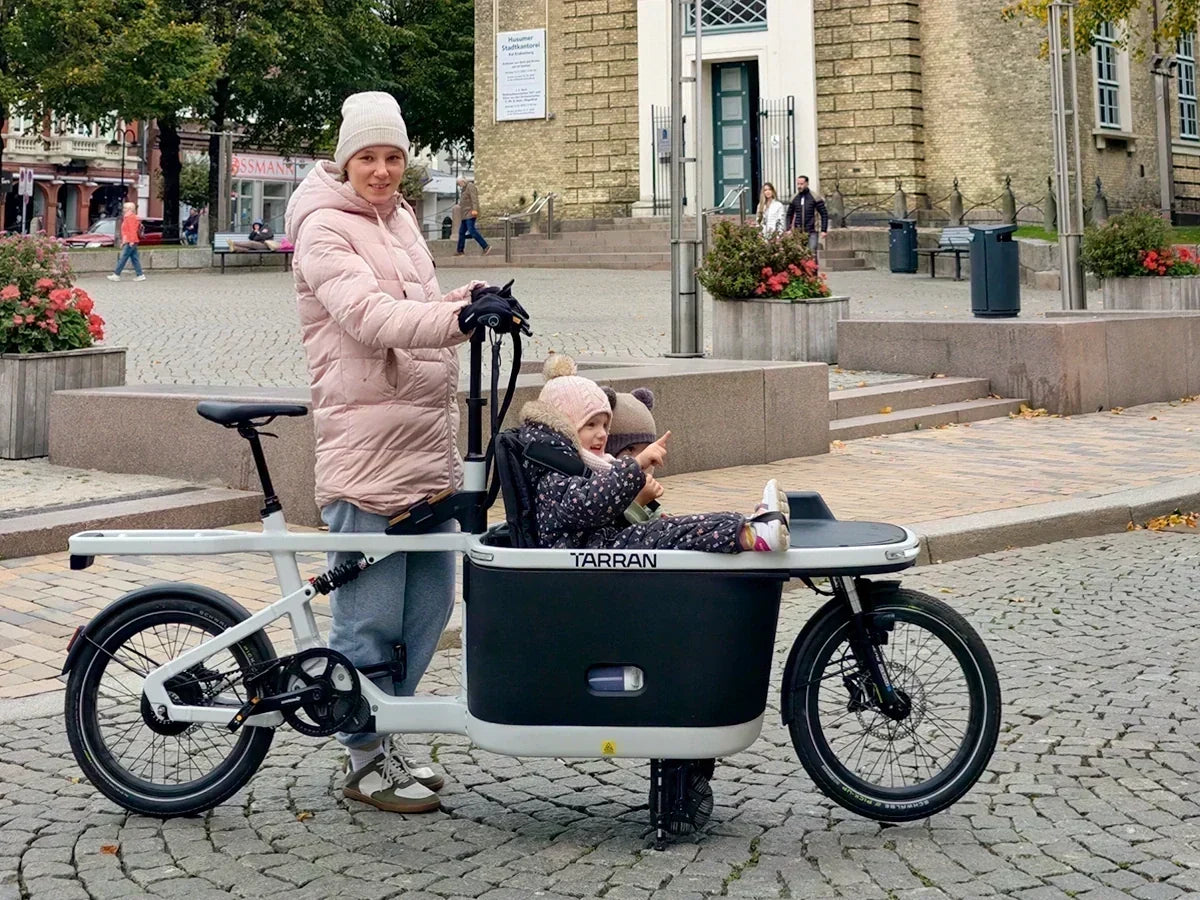
Whether a cargo bike fits through a door, gate, or basement rarely depends on the length and width in the specification sheet alone. The clear door opening, the widest point of the fully equipped bike, and the room available for maneuvering are what matter. Accessories such as a rain cover, panniers, child seats, or footrests can significantly increase the space actually required.
As a rule of thumb, the usable doorway should be several centimeters wider than the bike at its widest point. You also need enough space in front of and behind the door to align the bike straight. Measuring the entire route from the sidewalk to the parking space before buying helps avoid difficult lifting, jamming, or maneuvering in a basement corridor later.

What Are the Dimensions of Common Cargo Bike Designs?
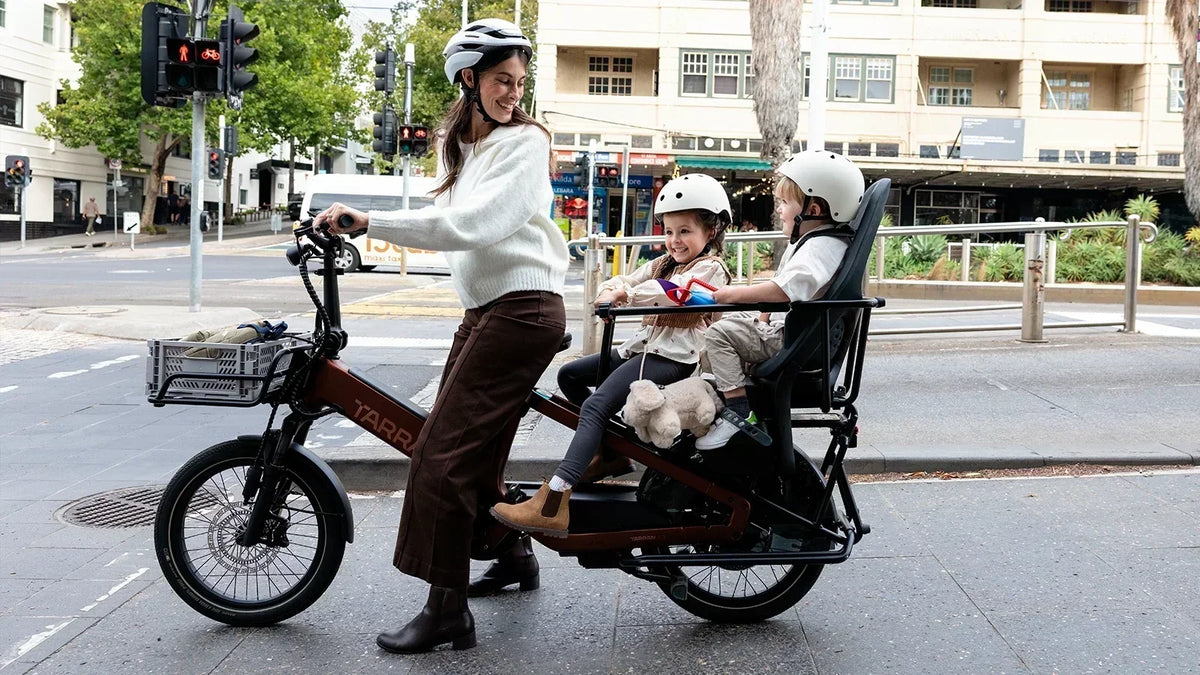
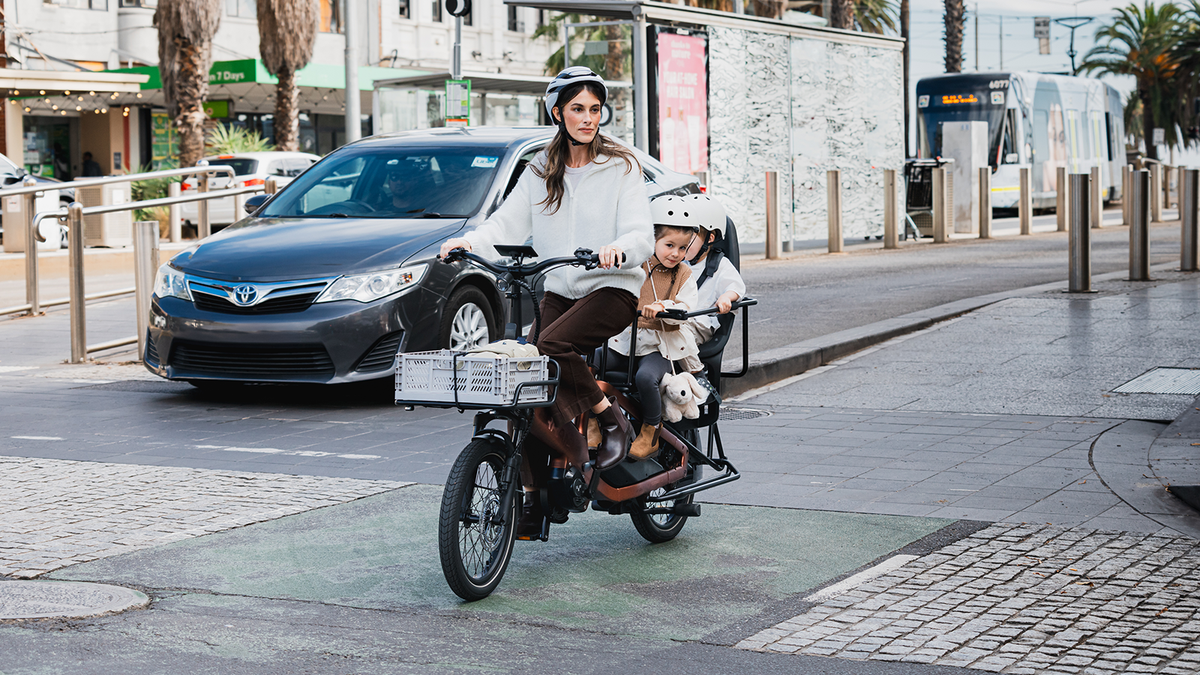
Common cargo bikes differ mainly in length and width. Longtails are generally narrow, but their extended rear racks make them longer than everyday bikes. Long Johns need more length in front of the handlebars, while two- or three-wheeled front loaders often require more width as well. “Cargo bike” is therefore not a useful measurement when checking a doorway.
For commercial child transport, the DGUV guidance may also be relevant; the specific dimensions of the model are still what count when checking available space. For private buyers, the publication offers guidance but does not replace model-specific dimensions. When checking available space, the actual width of the model is more important than a typical value for its design category.
Length, Width, and Design
|
Design |
Typical space required |
Common bottleneck |
Practical advantage |
|
Longtail |
long and generally as narrow as a conventional bicycle |
handlebars, wide bags, footrests |
narrow passages, standard bike lanes |
|
Long John |
very long, box in front of the handlebars |
box width, large turning circle |
|
|
Compact cargo bike |
shorter than many longtails |
accessories may increase the width |
elevators, basements, dense urban traffic |
|
Tricycle with front box |
often the widest design |
doors, bollards, slopes |
stable when stationary, large cargo area |
The table is a guide, not a list of exact dimensions. Accessories change the bike’s overall profile: a rain canopy may be taller or wider than the box, loaded panniers project farther outward, and a child seat increases the bike’s length or height.
Riding Dimensions and Parking Dimensions
A real example shows the variation within one brand. According to current product information, the TARRAN T1 Pro is 2.26 meters long. By contrast, the TARRAN L1 Series follows the longtail concept and, according to the current product page, can be parked vertically; a folding handlebar stem reduces its profile. These features address different space constraints.
Turning space is also part of a vehicle’s effective size. A bike that is 2.26 meters long may fit through a straight opening but still become stuck in a basement corridor with a right-angle turn.
What Door Width Is Sufficient for Everyday Use?
A door is wide enough when its clear opening is wider than the widest fixed point of the fully equipped bike and leaves a safety margin on both sides. An exact match, such as an 80-centimeter-wide bike and an 80-centimeter opening, will not work: steering, pushing, and slight angles require additional room.
Clear Opening and Safety Margin
Measure the clear width at the narrowest point with the door fully open. A handle, door closer, projecting frame, or second leaf can reduce the usable opening. For a courtyard gate, also account for stops, ground bolts, and posts. As practical guidance, a total side clearance of about five to ten centimeters can make pushing the bike through easier. More space may be needed depending on the bike’s weight, the approach angle, and any threshold.
Three measurements are useful for a practical check:
- Usable opening: the shortest distance between all fixed obstacles.
- Maximum bike width: check the handlebars, box, footrests, bags, and rain canopy.
- Approach space: the clear area in front of and behind the door that allows the bike to be aligned straight.
Thresholds, Door Leaves, and Approach Space
An inward-opening door can block the standing area, while a spring may push the door leaf against the bike. A step forces you to lift and steer at the same time. With a heavy cargo bike, this is very different from pushing it across level ground. A board used as an improvised ramp is only appropriate if it is slip-resistant, load-bearing, and approved for use with the building; for frequent use, a structurally safe solution is preferable.
How Should You Measure a Basement or Bike Room?
Treat the basement or bike room as a complete transport route: access, doors, turns, ramps, elevator, and parking area. The narrowest or steepest section determines whether the cargo bike is practical for daily use. A large storage room is of little value if the final basement door can only be reached through a tight reverse turn.

Measure the Entire Route
A reliable measurement process follows this order:
- Define the route first. Walk from the sidewalk to the parking space and mark every bottleneck, step, and turn.
- Measure the clear dimensions. Measure the width and height of open doors as well as the elevator cabin and elevator door.
- Check turning space. Record the corridor width, inside turning radius, and clear space before every change of direction.
- Assess slopes and thresholds. The length and rise of a ramp matter just as much as slippery surfaces or missing handrails.
- Allow working space around the parking spot. Include room for putting the bike on and off its stand, locking it, removing the battery, and walking past it.
Check Turns and Parking Space
A simple floor plan on graph paper can reveal conflicts. Draw the bike as a rectangle to scale and rotate it through the bottlenecks. This does not replace a real test ride, but it shows whether a 90-degree turn generally requires more room than is available. Vertical parking also requires sufficient ceiling height, including clearance from lights, pipes, and sprinklers.
Use of a shared bike room should also be coordinated with others. A cargo bike must not obstruct escape routes or access to technical installations. Building rules, the rental agreement, and local fire-safety requirements may apply; if in doubt, ask the property manager which area may actually be used.
When Do Folding and Adjustable Components Help?
Folding and adjustable components help when handlebar height or width is the critical bottleneck or when the bike is intended to be stored upright. However, they do not shorten every bike design and do not eliminate the need for adequate floor space to maneuver. What matters is which measurement actually changes in the intended configuration.
Components That Save Space
A folding handlebar stem can reduce the bike’s profile when it is parked vertically. A height- and angle-adjustable stem also makes it easier to fit the bike to different riders, but it must be placed in a repeatable position before passing through a doorway. Telescopic seatposts reduce height, while footrests or side panels fold in on some models.
According to current product information, the TARRAN L1 Series combines a folding handlebar stem with vertical parking and small transport wheels at the rear. This can make the upright longtail easier to maneuver, provided the corridor, elevator, and ceiling are sufficiently large. The ceiling height, the bike’s center of gravity when upright, and the manufacturer’s specified handling procedure must all be suitable. Do not raise a loaded bike into the parking position; remove children and loose items first.
Avoid Mistakes When Adjusting Components
Adjustability also creates an operating requirement. If the handlebars are released, folded, and readjusted every morning, the clamp and lock must be correctly secured. The model-specific instructions explain how to operate and check these parts. The current TARRAN manuals and downloads are the appropriate source; improvised settings can impair safe steering.
For safe parking, the DGUV information on cargo bikes specifies a sufficiently stable stand or, for multi-track cycles, a suitable parking brake. This is particularly relevant if the bike must briefly stand unsupported before a component is folded or adjusted.
How Much Parking Space Does a Longtail Need?
A longtail needs at least its actual length and width, plus room to dismount, lock it, and pull it out. For a convenient everyday parking space, the narrow outline on the floor is therefore only the starting point. Bags, child seats, and footrests determine how close a second bike can be parked.
Horizontal Space Requirement
For horizontal storage, measure the total length from the frontmost point of the front tire to the rearmost accessory. The width is the greatest projection, often the handlebars or loaded side bags. A maneuvering zone is needed in front of or behind the bike so that the front wheel can turn and the heavy vehicle can be moved. If the longtail must be pushed backward up a ramp, the space and physical effort required increase considerably.
Vertical parking can save floor space but shifts the requirement upward. Measure the total upright height, including the tires, mudguards, and rack. The floor must be level and load-bearing, the bike must have the intended standing or rolling function, and it must not be possible for someone to knock it over accidentally. In a low basement with pipes, horizontal parking may remain more practical despite requiring more floor area.
Vertical Parking
As part of the ALADIN cargo-bike parking facilities project Zukunftsnetz Mobilität NRW summarizes guidance on planning, dimensions, and design. It is not a binding standard for a private basement, but it supports a useful planning principle: there must be enough room beside the bike to park and remove it.
For a fair comparison, record the same values for every candidate: riding dimensions, parking dimensions, dimensions with accessories, and required turning area. This reveals whether a compact cargo bike genuinely fits better or merely appears shorter in the specification sheet.
Measure Your Available Space Now
The narrowest point on the route to the parking space determines which bike design will fit. Measure the doorway, turning area, and parking space. Compare these measurements with the fully equipped bike, including its canopy, bags, and footrests. You can use the TARRAN dealer locator to request a test ride. Bring your measurement sketch so you can test directly how easily the bike can be pushed, turned, and parked.
Cargo Bike Fit and Storage Questions
Will a Cargo Bike Fit Through an 80-Centimeter-Wide Door?
Sometimes. It depends on the maximum width of the fully equipped bike and the actual clear doorway. If both the bike and the doorway are 80 centimeters wide, there is no necessary clearance; handles, frames, bags, or an angled approach may prevent the bike from passing through. Measure the narrowest point and test the approach with the handlebars straight and the intended accessories installed.
Can a Longtail Be Parked in a Standard Bicycle Rack?
Usually only to a limited extent, provided the rack, spacing, and locking point are suitable for the longer and heavier bike. Front-wheel clamps may also be unsuitable; a sturdy leaning rail or designated cargo-bike space often provides more support and room. The bike must not project into walkways, doors, or traffic lanes.
Can a Cargo Bike Be Stored in a Shared Basement?
That depends on whether the rental agreement, building rules, fire-safety requirements, and clear escape routes permit it. The property manager can confirm the designated area; doors, meters, and technical installations must remain accessible. A marked parking space is preferable to leaving the bike in a corridor, even if it would physically fit there.
How Much Maneuvering Clearance Is Needed at a Door?
Several centimeters of side clearance are generally advisable, and more may be required for heavy bikes or an angled approach. The bike also needs enough space in front of and behind the door to align both the handlebars and frame. A trial with a cardboard box cut to the measured maximum width can provide an initial indication, but it does not replace testing the complete bike.
Can Every Longtail Be Parked Vertically?
No. The model and its standing or rolling contact points must be expressly designed for this purpose. Remove cargo and children before raising the bike, and make sure the ceiling height, floor, and handling procedure comply with the manufacturer’s instructions.

Leave a comment
This site is protected by hCaptcha and the hCaptcha Privacy Policy and Terms of Service apply.