

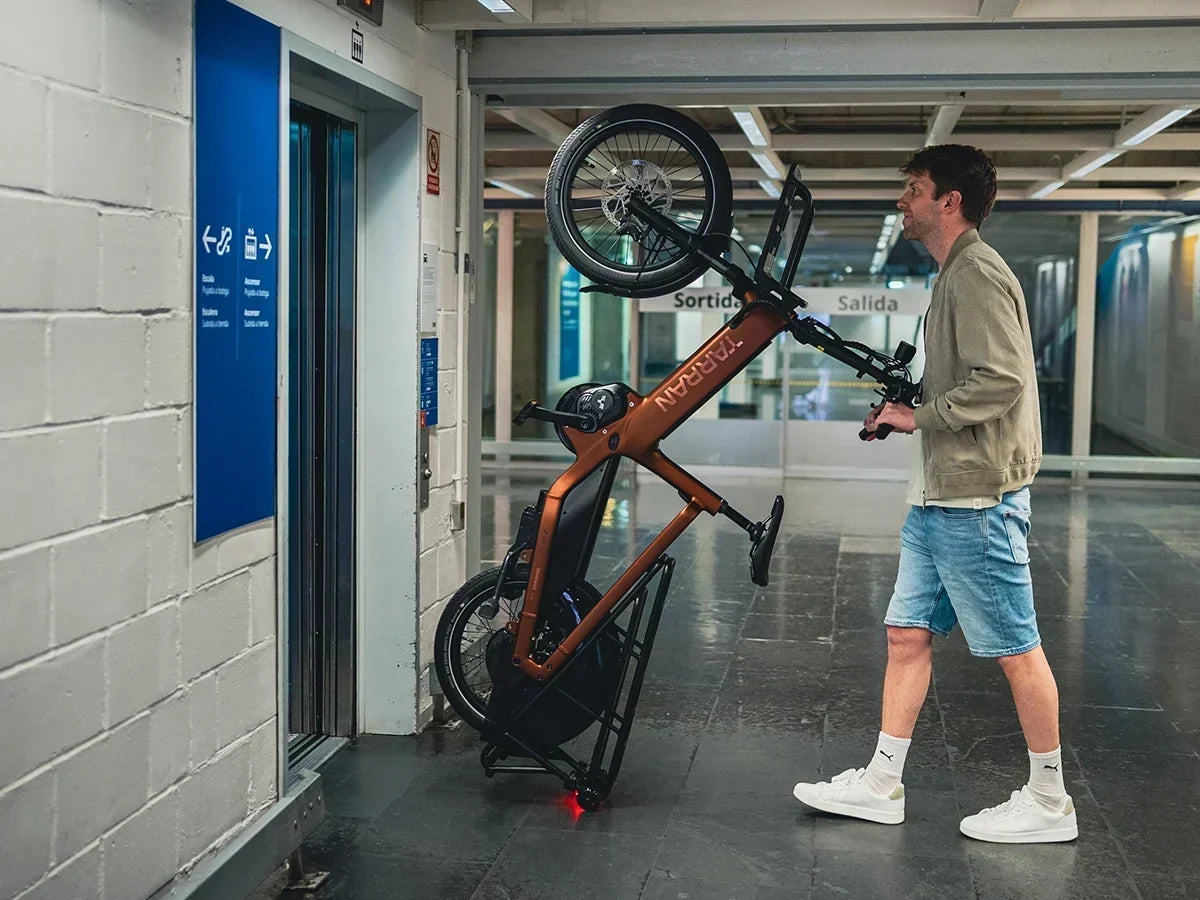
After a ride, the e-bike is often parked in the garage, basement or hallway, and the battery needs power for the next day. It can be charged safely there if the space is dry and tidy and there are no easily flammable objects right next to it. A special room is usually not necessary. What matters is a dry, well-ventilated and tidy place, a stable surface that is preferably non-combustible, sufficient distance from easily flammable materials and a suitable socket.
Whether it is a standard e-bike or an electric cargo bike, the battery and charger must not become damp or be exposed to excessive heat. Cables are best laid so that nobody can trip over them, and the manual for the specific model defines the proper limits for temperature and charging time. The following sections explain what matters when it comes to the charging location, the battery and the correct charger.
Which charging location is suitable at home?
A suitable place is dry, well ventilated and kept at a normal temperature, with a fixed wall socket. The battery and charger should lie or stand securely, away from direct sunlight, radiators, textiles, paper and other easily flammable materials.
A tiled utility room, a dry garage within the permitted temperature range or a clearly arranged basement area can be suitable. A bed, sofa, carpet or escape route is unsuitable. Do not charge inside a closed container either, unless the manufacturer expressly permits this use, because heat can build up.
Before connecting the charger, it is worth taking a quick look at the socket, cable, plug, charging port and battery housing. If the socket is loose, a cable is crushed or the battery smells unusual, charging must not begin. Multi-socket power strips and extension cables should not be the standard solution. If they are unavoidable, they must be rated for the required power, undamaged and safely routed; cable reels should be fully unwound.
Charge whenever possible at a time when you are awake and nearby. “Supervised” does not mean staring at the battery the whole time. However, you should be able to notice unusual heat, noises, smells or smoke early and react. In the event of a fire, do not put yourself in danger. Leave the area and call the fire brigade on 112.
Accessibility also matters. No bicycle, cable or piece of furniture should narrow the path between the charging location and the exit. Set up the charger so that its ventilation openings remain clear and neither children nor pets can reach the cable or battery. In apartment buildings, house rules, fire safety concepts or rules for shared areas may impose additional restrictions. Therefore, clarify the use of a basement socket with the landlord or property management instead of assuming that an existing socket automatically means charging is permitted.
For a permanently installed battery, the entire bike must be placed in a suitable location. A removable battery offers more flexibility, but it should be carried with both hands and not lifted by the cable or key. After inserting it, the lock must close audibly or noticeably. If there is play in the battery seat, check the installation instructions before riding or charging.

Why should the original charger be used?
Use the supplied charger or a charger expressly approved by the bicycle manufacturer. A matching plug alone does not prove electrical compatibility, because voltage, charging current and communication with the battery management system must also match.
The Consumer Advice Centre guidance on safe battery handling recommends using the intended charger, preferably the original one. A random universal charger or a power supply that merely looks suitable can damage the battery or bypass protective functions. For replacement parts, buy from the manufacturer or an authorised specialist dealer and compare the model designation and part number.
Connect the charger according to the sequence specified in the operating instructions. Often, the charging plug is first connected to the battery or bicycle and only then is the mains plug inserted; when disconnecting, the order is reversed. Since manufacturers may specify a different procedure, the manual is binding.
A second charger for the office or holiday home is practical, but only if approval is clearly confirmed. Do not compare only wattage or housing shape. Relevant factors include output voltage, maximum charging current, polarity, connector pin assignment, software communication and the exact battery version. If there is no clear assignment in the official documentation, have compatibility confirmed in writing by the manufacturer or dealer.
During charging, the charger may become warm to the touch. However, “warm to the touch” is not a measured value and not approval for every temperature. If it becomes noticeably hotter than usual, repeatedly switches off or displays an unknown flashing error signal, disconnect it according to the instructions and check the meaning of the code in the manual. A defect should not be improvised with adhesive tape, a new plug or a third-party power supply.
For branded models such as TARRAN, the charger is included with the respective model. On the page for the TARRAN L1 series, for example, a charger intended for this model series is listed. Compatibility with another model should not be inferred from this. Instead, check the official TARRAN manuals or ask support for the exact matching replacement.
What temperatures make sense when charging?
Charging is most sensible at moderate room temperature within the manufacturer’s limits. A cold battery should first be allowed to acclimatise slowly after a winter ride, while a strongly heated battery must cool down before charging.
The ADAC note on charging at room temperature explains that a battery that is too cold does not charge optimally. However, giving one blanket temperature value for every system would be inaccurate. The permitted charging range in the instructions for your battery remains decisive.
If the battery comes from freezing conditions into a warm room, condensation can form. Wait until the battery and contacts are dry and the housing has reached room temperature. Do not speed up warming on a radiator and do not use a hairdryer. After a ride in summer heat, the reverse applies: allow the battery to cool down in the shade and do not charge it in a heated car or in direct sunlight.
A simple everyday aid is a thermometer in an unheated basement or garage. It does not replace the battery instructions, but it shows whether the room is regularly outside the intended range. If the temperature fluctuates strongly, take a removable battery into a suitable indoor room to acclimatise. Place it on a solid surface and keep it away from heat sources. Only when no moisture is visible and the battery appears normal should the intended charger be connected.
Also plan enough time. A cold or hot battery should not be charged “quickly” immediately before an urgently needed ride. If you check the charge level the evening before, you can plan acclimatisation and charging time without pressure. This is especially helpful for electric cargo bikes, whose batteries often have to support longer distances or higher loads in everyday use.
When does a battery need to be checked?
A battery must be professionally checked before the next use if it has been dropped, suffered strong impacts, become deformed or heated up unusually strongly. Cracks, loose parts, leaking fluid, an unusual smell, hissing, smoke or suddenly much shorter range are also warning signs.
According to the DEKRA guide to e-bike battery care, a battery damaged by a fall, overheating or incorrect charging can trigger a short circuit. Do not open or repair such a battery yourself. Disconnect it from the mains or bicycle only if this can be done safely, and contact a qualified specialist workshop or the manufacturer.
Even if a battery looks normal from the outside, it may still be damaged after a hard impact. The appropriate inspection depends on the system and may include diagnostic values, plug contacts and the housing. In the event of recalls or error messages, the manufacturer’s instructions are decisive. For TARRAN models, model-specific documents are available in the help centre.
Distinguish normal signs of use from warning signs. Small scratches on the outer housing do not automatically indicate cell damage, while a new bulge, a crack along the seam or scorched contacts must be taken seriously. Document abnormalities with photos and note whether a fall, water ingress or charging error occurred beforehand. This information helps the specialist workshop assess the situation.
If the range decreases gradually, this may be related to age, temperature, tyre pressure, route, assistance level and load. A single short ride value therefore does not prove a battery defect. If the deviations suddenly become large or the assistance repeatedly cuts out despite a displayed remaining charge, a diagnostic check makes sense. Until the issue is clarified, do not use a damaged charger and do not test the battery by swapping it with a model that only appears to fit.
How do you store a spare battery safely?
Store a spare battery in a dry, cool and frost-free place, away from heat sources, direct sunlight and easily flammable objects. The charge level should be within the range specified in the manufacturer’s instructions, not automatically at 100 percent.
For several weeks or months of storage, regular checks are recommended. Inspect the housing and contacts, read the charge level and recharge only if the instructions require it. Deep discharge can damage the battery, while permanent full charging can accelerate ageing. Exact limit values differ depending on the battery management system and model.
Protect exposed contacts from metal parts, dirt and moisture. The battery should not lie loosely on a shelf from which it could fall, and it should not be within reach of small children. Additional rules apply to travel, shipping and disposal. Damaged or end-of-life batteries do not belong in household waste, but should be taken to a suitable collection point or specialist dealer.
Label multiple spare batteries so that they remain assigned to the correct bicycle without covering warning notices or serial numbers. Do not use a metal box as a blanket fire-protection solution. An unsuitable, tightly closed container can trap heat and make observation more difficult. If the manufacturer offers a specific storage or charging container, follow its purpose and instructions exactly.
Before the first ride after longer storage, check the charge level, housing, locking mechanism and contacts. Insert the battery only when everything is dry and clean. A short test ride without a heavy load can show whether the display and assistance are working plausibly. In the event of error messages, the model-specific manual helps, not a general error code from a different e-bike system.
Set up the charging location safely now
A safe charging location is created through a few consistent decisions. Set it up properly once and check before every charging process whether the battery, charger and surroundings are still suitable.
|
Priority |
Checkpoint |
|
1 |
Choose a dry, stable and non-combustible surface |
|
2 |
Use only the approved charger |
|
3 |
Check the battery for damage, moisture and temperature |
|
4 |
Stay nearby during charging |
|
5 |
Disconnect after charging and store cables neatly |
If your bicycle with electric assist uses a permanently installed or model-specific charging system, read the corresponding manual first. Anyone who owns a TARRAN model or is looking for a suitable e-bike in Germany can check the latest information on bicycles, batteries and accessories in the official overview. There you will also find the TARRAN accessories collection. Choose a charger or spare battery only for the exact model named and clarify any open compatibility questions before purchase.
E-Bike Charging Safety Questions
Can I charge the e-bike battery overnight?
Better not if you are asleep and cannot notice the charging process. Charge whenever possible at a time when you are awake and nearby. If the manufacturer expressly allows charging over longer periods, the charging location must still be dry, free of combustible materials and easily accessible.
Can the battery remain in the bicycle while charging?
That depends on whether the model is designed for charging on the bicycle and whether the parking location is suitable. Follow the instructions, secure the bike against tipping over and protect the charging port and plug connection from moisture and pulling strain.
Does a new battery need to be fully discharged first?
No. Modern lithium-ion batteries generally do not require a complete discharge cycle. Intentional deep discharge should be avoided. Follow the specific manufacturer’s instructions for the first charge and any possible calibration.
Can I charge a wet battery immediately?
No, not as long as the housing, charging port or contacts are damp. Let everything dry completely at room temperature, do not use hot air and then check for visible damage.
What should I do with a swollen battery?
Do not continue charging or using it. Keep your distance, avoid pressure or attempts to open it, and contact the fire brigade immediately if there is heat, smoke or smell. If there are no acute signs, the manufacturer or specialist workshop should clarify the next steps.


Leave a comment
This site is protected by hCaptcha and the hCaptcha Privacy Policy and Terms of Service apply.