

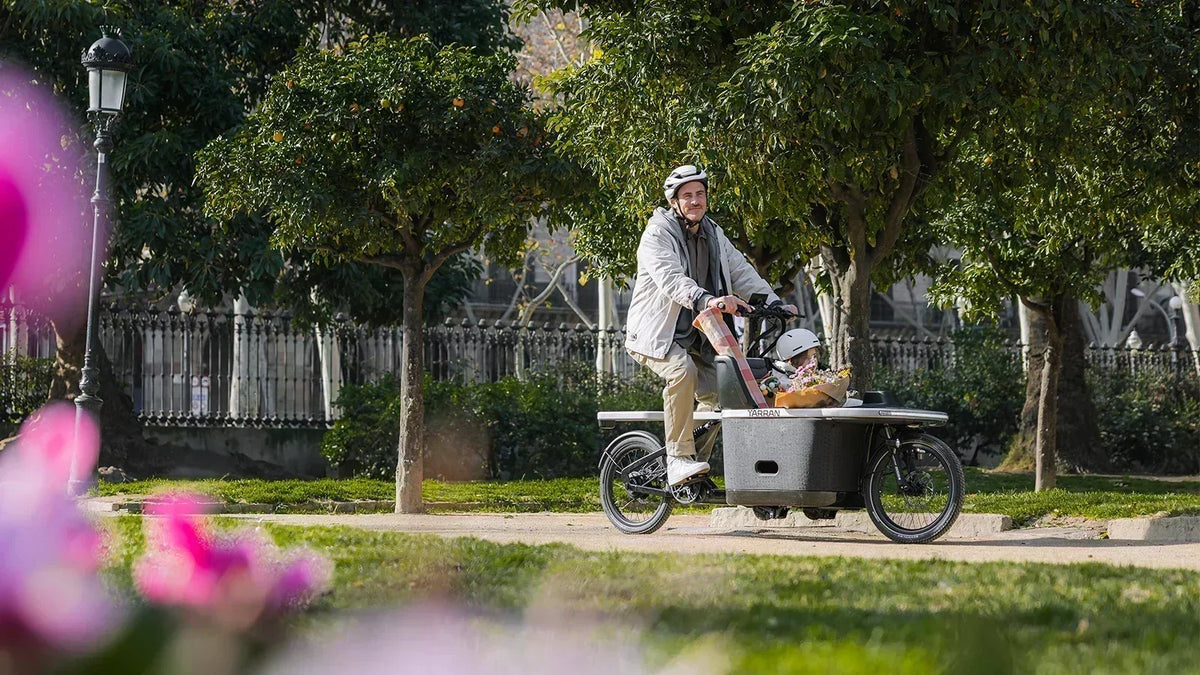
With clear separation, children and the weekly shop can safely fit in the same cargo e-bike. Morning drop-off at daycare, then on to the supermarket: on everyday trips like these, what matters is that the children sit comfortably and that no bag slides into their area during braking.
Seats, belts and foot space belong to the children. Drinks bottles, milk or tins are kept separate from them, in the area where the cargo bike carries shopping. Fruit, lunch boxes and small packages stay in place inside closed bags.
A fixed order makes loading easier: first seat the children safely, then distribute the shopping by weight, and finally close all bags. A quick check of belts, weight and visibility before setting off shows whether everything is ready.
Which load needs to be secured first?
The children first sit in the places intended for them and are secured with the appropriate restraint system. Only when belts and foot space are clear does it become apparent how much space is actually left for the shopping. The bike should be standing on a level surface and secured against rolling away or tipping over.
According to Section 21 of the German Road Traffic Regulations (StVO), people may only be carried on bicycles if the bicycle is built and equipped for passenger transport. Additional requirements apply to children under seven years of age: the person riding must be at least 16 years old, suitable seats must be available, and the children’s feet must be protected from getting caught in spokes or moving parts. Regardless of age, the manufacturer’s information on seats, belt systems, weight and permitted use also applies. Details on size, seating position and belt system can be found in the manual for the respective model:
- Park the cargo e-bike securely on a level surface
- Check the seat, belts and foot space
- Seat the children and fasten their belts
- Distribute the shopping by weight across the designated areas
- Close bags and secure them against slipping
- Before setting off, check space, visibility and total weight
Drinks bottles, tins or jars do not belong loose next to the children. During hard braking, even small objects can quickly become a problem. If there is not enough separate storage space, a second trip is the better choice than an overloaded box.

Where should heavy shopping go?
Heavy shopping should be placed low and where the load is intended to go on the respective bike. This keeps the cargo bike more stable than if crates of drinks or bottles are stacked high or placed only on one side.
In its guidance on riding cargo bikes, the ADAC also recommends storing heavy items as low as possible. If light, bulky cargo protrudes beyond the transport box, a suitable net can help. However, heavy or hard objects must stand on a stable loading surface and also be secured against slipping. The manufacturer’s limits and clear visibility must not be exceeded.
Two bags of similar weight are better placed on opposite sides than both on the left or both on the right. On a cargo bike with a front box, the bench seat, belts and foot space remain clear. The motor helps when starting off, but it does not compensate for poor weight distribution.
At the drinks store, the difference becomes obvious immediately: a crate stands securely on the floor of the intended loading area and is secured against sliding. If it only fits upright or blocks the children’s exit, this loading arrangement is not suitable for combined transport.
For weight, the bike, rider, children, accessories and all shopping count together. In addition, the load limits for the box, luggage rack and seat each apply. These values are listed in the manual and apply regardless of motor power.
The children’s area remains reserved for children
On the way to daycare, jackets, drinks bottles and a shopping bag can quickly end up in the box. Even so, the seating area, belts, foot space, and entry and exit area must remain exclusively free for the children. Shopping goes into separate bags or onto a luggage rack intended for that purpose.
Nothing belongs between the children’s feet. Bag handles can easily get caught on shoes, and hard packaging can knock against legs or knees on cobblestones. Toys and drinks bottles therefore also need a fixed place.
- The belts lie flat and are not covered by jackets or bags.
- Feet, hands and clothing stay away from wheels, spokes and moving parts.
- The children sit comfortably without having to hold a shopping bag.
Under a rain cover, the head and shoulders need enough room. A full bag must not push the cover inward or block the exit. In an emergency, the children must be reachable without first having to unload a crate of drinks.
A short ride on quiet ground shows how the bike handles with children and which storage space is still easy to reach. If a new bag or another seat is added later, the same test helps again: start, steer and brake once before entering traffic.
Closed bags keep small items in place
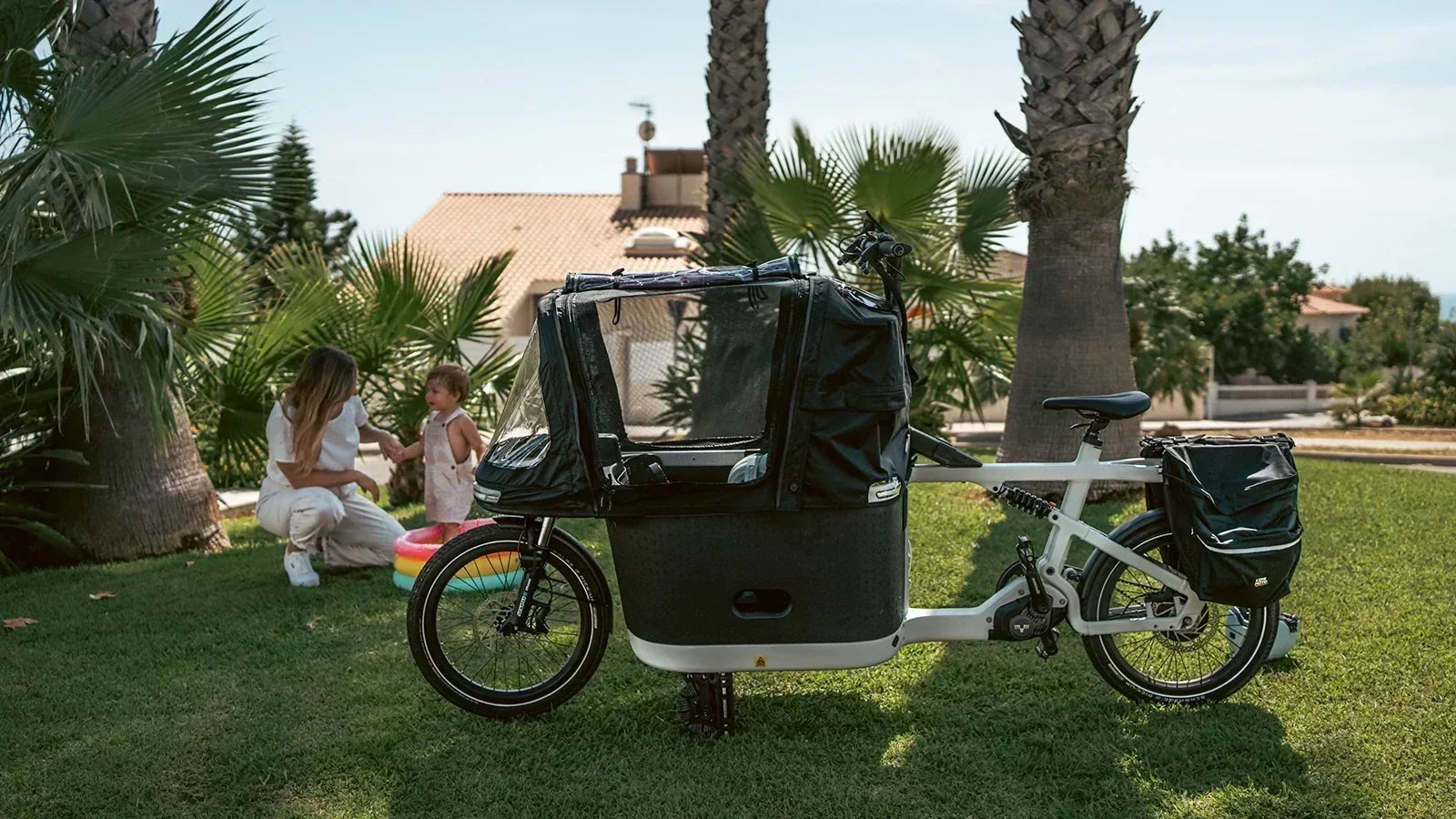
After a supermarket visit, apples, keys and small packages can quickly end up loose among larger purchases. Closed, firmly mounted bags keep such items together. They sit on the designated carrier, do not swing sideways and stay away from the wheel, lights and belts.
Panniers are suitable for tins, non-perishable foods or compact household items. For chilled shopping, a securely attached cooler bag may be suitable. Small items are best placed in a zippered compartment instead of lying on top of an open bag.
With branded models such as TARRAN, accessories are matched to specific models. The TARRAN accessories overview lists, among other things, panniers, a cooler bag with storage space and a frame bag referred to there as a rear triangle bag. The product page shows which model and attachment point each accessory is intended for.
| Criterion | What you should pay attention to |
| Attachment | The bag sits on the designated mounting points and cannot swing. |
| Closure | Even on uneven ground or during braking, the contents remain inside the bag. |
| Position | Wheels, brakes, lights and children’s seats remain clear. |
| Weight | Bag, carrier and bicycle remain within their respective limits. |
A net keeps light, bulky items together, but it does not replace a stable base. Bottles and jars stand securely in a bag or box; a loosely placed net over the top does not prevent them from knocking against each other or sliding sideways.
Check weight and visibility before riding
Before setting off, the total weight matters just as much as clear visibility. Bags or rain covers must not obstruct the handlebar and brake levers, lights, mirrors or camera.
The total must not exceed the permissible gross weight stated in the manual:
- Kerb weight of the cargo e-bike
- Weight of the rider
- Weight of all children
- Weight of seats, bags and other accessories
- Weight of all shopping
In addition, the individual limits for the box, luggage rack, seats and accessories apply. The permissible gross weight must not be exceeded overall; at the same time, the lowest relevant limit applies to each loading zone.
According to current manufacturer information, the permissible gross weight of the TARRAN T1 Pro is 220 kg. The product page also states separate values for the cargo box, rear seat and rider weight. These figures apply to the T1 Pro and cannot be transferred to the TARRAN L1 series or another cargo bike.
Pushing the bike a few metres can reveal a lot: if the loaded bike pulls clearly to one side, is difficult to bring upright or a bag touches the wheel, the distribution is not yet right. On an open area, a short test follows with starting, steering and braking.
In the first few minutes of riding, it becomes clear whether belts and bags stay in place. After cobblestones, a kerb or hard braking, a short stop is worthwhile. If a fastening has come loose, continue only after tightening it again.
Divide the loading zones sensibly now
When transporting children and shopping together, one simple decision applies: anything that affects the children’s space, the permissible weight or control of the bike does not come along. In everyday life, this limit is more helpful than trying to fill every free centimetre.
At TARRAN, seat systems and bags are each matched to a specific model. The combination intended for your bike is listed in the model-specific TARRAN manuals. Anyone who regularly transports children and a large shop can test this combination during a test ride with realistically distributed weight. This shows before purchase whether seats, storage space and handling suit everyday family life.
Cargo Bike Child and Shopping Safety Answers
Do two children and a weekly shop fit in every cargo bike?
No. That depends on the seats, the separate storage space and the weight limits of the specific model. If there is no safe space left for the shopping, two trips or additional suitable panniers are the better solution.
Can a child hold a shopping bag on their lap?
Better not. A bag on the lap can slip during braking, interfere with belts or tempt the child to hold on to it. Shopping should be secured separately, while hands, belts and seating position remain free.
Can a backpack hang from the handlebar?
Usually not, because a swinging backpack can interfere with steering or get caught in cables and brake levers. A designated luggage rack or a firmly mounted bag is better.
Do fragile groceries need extra protection?
Yes, if jars, bottles or delicate packaging are being carried. They should stand upright, separated from one another and secured so firmly that they do not knock against each other on uneven ground.
Does the load have to be secured again after every stop?
No, provided nothing has been removed or added and all fastenings are still unchanged. After a shopping stop, a bumpy route or a hard braking manoeuvre, a quick look shows whether a bag or belt has come loose.

Leave a comment
This site is protected by hCaptcha and the hCaptcha Privacy Policy and Terms of Service apply.