

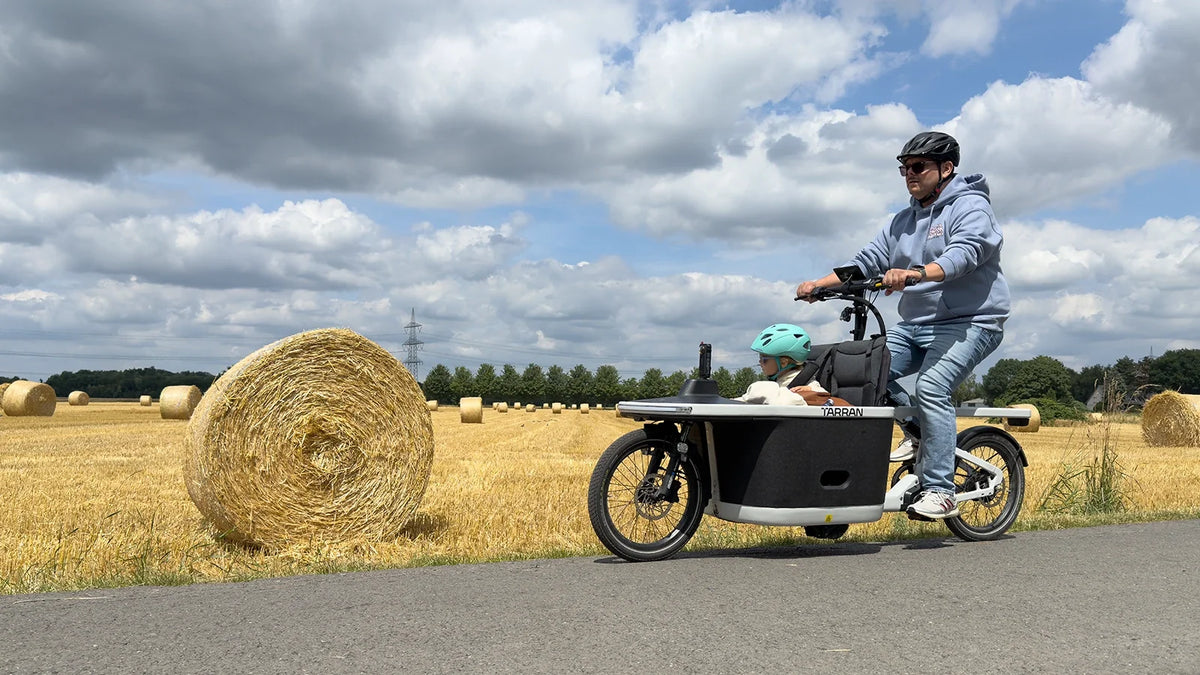
A fully loaded cargo e-bike needs two independent, easily controllable brakes with sufficient thermal reserve. For heavy family and transport models, hydraulic disc brakes, often with four pistons, resilient pads, and large or particularly thick rotors, are a plausible technical starting point. Five testable points are crucial: total weight, axle load, piston and lining area, rotor diameter, rotor thickness, and a clear pressure point.
No single number answers the question alone. Four pistons often improve dosage and reserves, a larger rotor increases the lever arm, a thick rotor stores more heat, and a suitable tire must transfer the deceleration to the road. Only this interaction shows whether the brake is suitable for repeated stops and longer gradients.
Why Does Braking Demand Increase with Gross Weight?
The kinetic energy to be converted during braking can be described as Eₖᵢₙ = ½ · m · v². If the mass doubles at the same speed, the energy doubles. On the other hand, if the speed doubles, the energy quadruples. That's why a heavy cargo bike not only puts a little more strain on the brakes at 25 km/h than at 12.5 km/h, but also has to convert around four times the kinetic energy into heat.
When decelerating, the wheel load moves forward. This means that the front wheel brake can usually transmit more braking force, while a rear wheel that locks too early results in little additional deceleration. The front box, long-tail rear, driver position and trailer change the axle loads. When comparing brakes, you not only look at the total weight, but also the load distribution and the longest regular descent.
Section 65 StVZO requires two independent brakes for bicycles. For cargo bikes, the EN 17860 series of standards supplements the general bicycle requirements with load carrier-specific tests. The current DIN EN 17860-2:2025-06 deals with lightweight single-track cargo bicycles and replaces the requirements and test methods of the previous DIN 79010 for this area. Which parts of the series apply depends on the design, weight and use.
On a long descent, the energy is converted into heat not just once, but again with every deceleration. Continuously lightly pulled levers keep the rotor and pad at a high temperature and leave little time for cooling. Short city stops, a steep gradient and emergency braking therefore pose different requirements, even though the bike and load are identical.
A calculation example with real values makes the magnitude visible: For the TARRAN T1 Pro, the current German product page states a wheel weight of 65 kg and a maximum total weight of bike, rider and load of 220 kg. If you add 75 kg of driver weight, 40 kg for two children and 15 kg of purchases, the result is 195 kg, i.e. around 25 kg reserve up to the limit. In addition, partial limits apply to the driver, front box and rear; the smallest applicable value limits the load.
A trailer increases the mass to be decelerated and can change the driving behavior when braking. Without its own trailer brake, the towing wheel's braking system has to absorb the additional kinetic energy. A trailer therefore only belongs on a cargo bike intended for this purpose; Coupling, permissible masses, load and, if necessary, a trailer brake are checked according to the documents for both systems. A careful test drive is initially carried out without children.
How Do Two- and Four-Piston Brakes Differ?
Four-piston calipers press the pad at several points and often work with a larger pad area. In heavy e-bikes, this often improves controllability, wear distribution and thermal reserve. Two-piston brakes can still work convincingly with moderate weight and a suitable rotor-pad combination; The number of pistons is a selection criterion, not a seal of quality.
Ultimately, the braking distance is limited by tire grip, the surface and the manageable wheel load. Additional pistons primarily help to build up the available braking force in a controlled and repeatable manner. They do not compensate for oily pads, low tire pressure, loose loads or incorrect handling.
For the comparison, four questions are more helpful than the number of pistons alone: How large is the effective pad area, how constant does the pressure point remain, what rotor thickness does the saddle handle, and which pads are intended for long descents? A well-tuned two-piston system can make more sense than a four-piston caliper with an unsuitable rotor or incorrect lining.
For smaller hands, the grip width is important for safety. The lever must remain accessible without the wrist bending sharply or the hand leaving the handlebars. There should be a clear pressure point before the lever touches the handle. If the lever travel moves, there is not automatically too little “braking force”; Air, leakage, piston movement or wear are possible causes.
Useful equipment can be specifically described: hydraulic disc brakes with easily accessible levers, sufficient pad area, rotors designed for high loads and documented wear limits. Four-piston calipers and additional thermal reserve are particularly useful when transporting children regularly, with frequent stops or downhill gradients.
Brakes and tires must work together to create enough grip. Even a powerful four-piston brake cannot shorten the distance arbitrarily if an unsuitable, worn or incorrectly inflated tire slips early. Tire condition and air pressure should therefore be checked before driving. The load is firmly secured so that it does not swing forward or suddenly change the weight distribution when decelerating. Additional reserve is required on loose ground, wet leaves and metal surfaces. If you regularly ride with a full load, practice controlled braking without children on a suitable, cordoned off area or in professional cargo bike training.

Which Brake Rotor Size Makes Sense?
Read diameter and thickness together
Rotor diameter and rotor thickness solve different tasks. A larger diameter increases the lever arm and the radiating surface. More thickness increases the steel mass and thus the heat capacity for the same diameter; in addition, more material remains up to the wear limit. For cargo e-bikes, not only 180, 203 or 220 mm are interesting, but also 1.8 versus 2.3 mm.
The TARRAN T1 Pro uses TRP C2.3 hydraulic brakes with 180mm rotors and 2.3mm output thickness. Many conventional bicycle rotors start at 1.8mm; 2.3 mm is mathematically around 28 percent thicker. With the same diameter and comparable material, more steel mass is available to absorb heat. The TRP rotor instructions list 1.8 and 2.3 mm rotor classes separately.
This makes it understandable why a 180 mm rotor is not automatically designed to be weaker than any larger disc. With the T1 Pro, the diameter, 2.3 mm thickness, brake caliper, pad and the maximum total weight of 220 kg form a documented system. The statement is not a general replacement for 203 or 220 mm: a thinner rotor or a different cargo bike may require different reserves.
A larger rotor delivers more braking torque with the same manual force, but puts different strain on the mount, adapter, fork and hub. A thicker rotor requires a caliper with a suitable piston travel. Retrofitting according to the principle “bigger is always better” can therefore cause grinding, incorrect pad contact or impermissible component loading.
The wear limit remains binding regardless of the initial thickness. A 2.3mm rotor may not be extended to 1.8mm if its instructions specify a higher minimum thickness. Measurements are taken at the intended location using a suitable tool; Visible scoring, warping or heat spots are additional reasons for a professional inspection.
Understanding brake fade and brake fluid
TRP systems like the C2.3 work with mineral oil. Mineral oil does not absorb moisture from the environment in the same way as hygroscopic DOT fluid. DOT can develop a lower wet boiling point over time due to absorbed water; Mineral oil ages differently, but is also not maintenance-free. Both types of liquid are chemically different, should never be mixed and will only be replaced with the exact specified liquid.
Brake fade has more than one cause. At high temperatures, the coefficient of friction between the pad and rotor can decrease; the lever then remains relatively fixed while the deceleration decreases. If the brake fluid heats up to the point where vapor bubbles form, compressible gas bubbles are created in the hydraulic system: the pressure point becomes soft and the lever travel becomes longer. Odor, smoke, discoloration or a moving pressure point requires a safe stop and inspection after cooling.
How Can You Recognize Declining Braking Performance?
These warning signs indicate that the brake system should be checked immediately:
- Moving pressure point or unusually long lever travel
- Rubbing, metallic grinding or new loud noises
- noticeably longer braking distance under comparable conditions
- diminishing effect with repeated braking or descents
Wear is measured separately on the pad and rotor. Metallic grinding, a shifting pressure point, new vibrations or a significant decrease in effectiveness are not an invitation to pull the lever harder, but rather a reason to stop. Oily cleaners and chain care products do not belong on the rubbing surfaces.
The current legal basis applies to Pedelecs with support up to 25 km/h, which are treated as bicycles. S-Pedelecs up to 45 km/h are motor vehicles and are subject to the vehicle class and type approval. Section 41 StVZO contains the general framework for motor vehicle brake systems; The specific design also depends on the respective vehicle class and approval. The bicycle requirement from Section 65 alone is therefore not sufficient for an S-Pedelec.
Brake pads may still appear to be present on the outside, even though their usable layer is almost used up. Measurements are taken at the location provided by the component manufacturer. Rain, road salt, dirt, high mass and frequent descents accelerate wear; A fixed kilometer value is therefore less meaningful than regular visual and thickness inspections.
New noises provide clues, but no reliable remote diagnosis. Squeaking can come from wetness, glazing or contamination; Grinding can indicate a crooked saddle, a bent rotor, or an incorrectly installed wheel. The decisive factor is the combination of noise, pressure point, measured thickness and actual deceleration.
Specific information helps for a targeted diagnosis: current total weight, typical load, most common slope, time of occurrence and last maintenance. The question is not a general question: “How do I get more braking power?”, but rather, for example, “Why does the pressure point become longer after five braking applications?” or “Which component is reaching its wear limit?”
Organic coverings often respond quietly and are easy to dose. Metallic or sintered versions can work more consistently in wet conditions and high temperatures, but are not intended for every rotor and can change noise and wear. Lining, rotor and saddle are viewed as a friction pairing; Left and right in the same saddle have identical, jointly renewed pads.
What Should the Test Ride Demonstrate?
The test drive should demonstrate three characteristics: a clear, repeatable pressure point, controllable deceleration without locking wheels and stable load. Entry is unloaded on a flat, traffic-free area. Only when both brakes react individually and together in a predictable manner will everyday loads be correctly secured within the documented limits.
- Several moderate stops without a moving pressure point
- Controlled stopping from a typical everyday pace
- Safe braking in a slight curve without load movement
- No grinding noises or excessive heat after a short series of tests
Steep descents or emergency braking are not a suitable initial test. New pads and rotors only reach their intended friction pairing after the braking procedure described. You can then check on a suitable surface whether several moderate stops provide the same pressure point and a comparable deceleration.
The levers must be accessible from the normal grip position. During the slow test, the wheel stays on track, the load does not move and no rotor grinds permanently. After a short series, do not touch the window with your hand; Heat, smell and changes in lever travel are assessed from a safe distance.
Regenerative braking or motor braking are not a replacement for mechanical brakes. Some hub motor systems can recover electrical energy during deceleration; many mid-drive motor systems cannot do this in terms of design. Even existing regenerative braking depends on the battery, control and system status and must not be planned as a reliable operating or emergency brake.
After working on the wheel or brake, a controlled functional test follows. For an approved trailer, the test is then repeated with an empty trailer and only then with a correctly loaded trailer. If the braking distance changes significantly, the team starts to push or the load sways, the test ends and the combination is subject to technical inspection.
Have the Braking System Checked
For a heavy cargo e-bike, hydraulic disc brakes with clear dosage, sufficient pad area and high thermal reserve are the most convincing starting point. Four pistons, larger rotors or 2.3 mm discs are concrete ways to achieve this reserve. Which combination is right is determined by the total weight, gradient, repeated braking and the condition of the friction partners.
With the TARRAN T1 Pro, the 180 mm rotors with a thickness of 2.3 mm and the maximum total weight of 220 kg can be assessed together. Using the TARRAN dealer search, test drives, wear measurements and model-specific maintenance can be coordinated without looking at individual components in isolation.
FAQs about cargo bike brakes
Are hydraulic brakes mandatory for every cargo bike?
No, the law does not prescribe this type of construction across the board. However, for heavy e-cargo bikes, hydraulic disc brakes are often the solution chosen by the manufacturer due to controllability and reserves.
Are four pistons always better than two?
No. Four pistons often offer more pad area, controllability and thermal reserve. Tire grip, rotor, pad, lever ergonomics and maintenance status remain just as important.
When do brake pads need to be replaced?
When the minimum thickness specified in the instructions has been reached, performance decreases or pads are damaged or contaminated. If in doubt, have a specialist workshop check the pads and rotor together.
Can a larger brake disc be easily retrofitted?
Not across the board. Larger or thicker rotors change leverage forces, installation space and load on the mounts; Saddle, adapter, fork, frame and hub must fit the desired dimensions.
How often should the brakes of a cargo e-bike be checked?
This depends on weight, route profile, weather and driving performance. If you often drive fully loaded or downhill, check the pressure point and visible wear regularly and adhere to the intervals in the model and brake instructions.

Leave a comment
This site is protected by hCaptcha and the hCaptcha Privacy Policy and Terms of Service apply.