

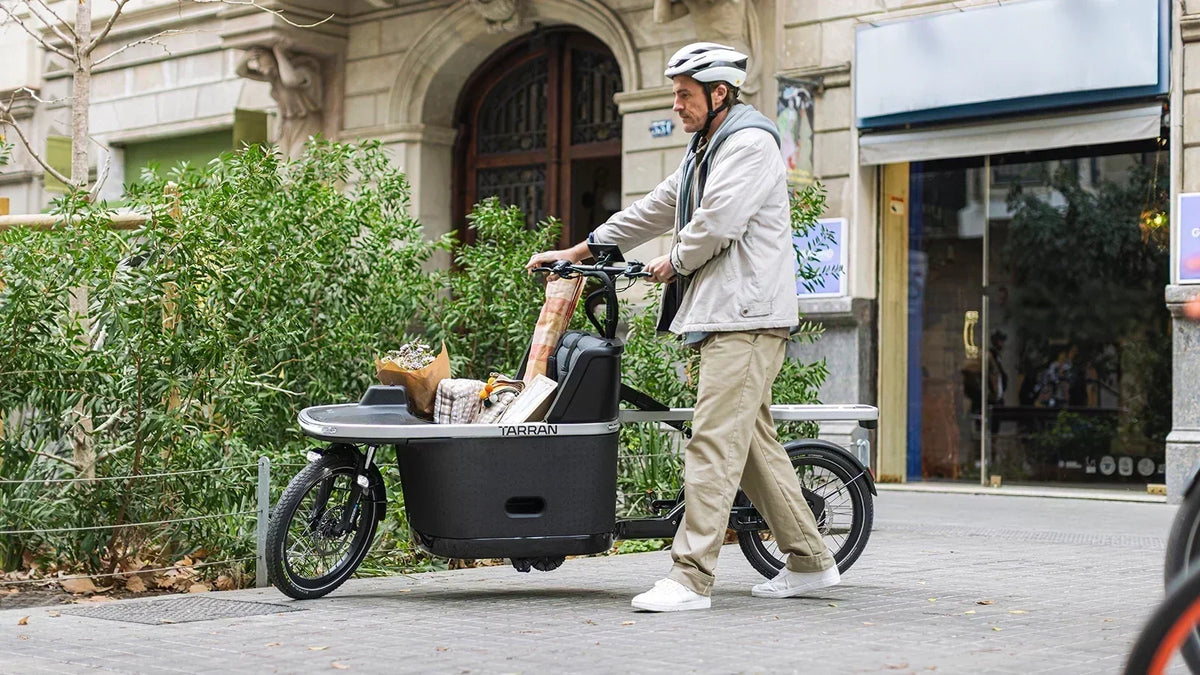
For an electric cargo bike with a high payload, lots of stops or hilly paths, a mid-drive motor is usually the more versatile choice. A hub motor, on the other hand, can impress with direct power transmission, a simpler drivetrain and often quiet city operation. The terrain, load, circuitry, sensors and the position of the motor in the overall concept are crucial.
Not every drive in a category drives the same. Torque sensor, gear ratio, software and permissible total weight influence behavior more than the label alone. A loaded test drive therefore remains the best comparison.
How Do the Two Drive Systems Differ?
The mid-drive motor is located on the crank and transmits its power to the rear wheel via a chain or belt and the gears. This allows it to use the available gears. A hub motor is located in the front or rear wheel and drives it directly, usually independently of the bicycle gears.
With a mid-drive motor, human and electrical power work together on the drivetrain. This creates a natural driving experience, but increases wear on the chain, sprockets or belt components under high loads. The hub motor relieves these parts of the motor power and in return adds additional weight to a wheel.
With the mid-drive motor, the support comes from the bicycle gear ratio. A lower gear allows the motor and rider to crank faster at low speeds, which can be more beneficial on an incline. If you stop at a traffic light in high gear, you are wasting this advantage. Automatic and hub gears, which can change to a light starting gear when stationary, reduce this operating error, but must be enabled for the motor torque.
The hub motor does not know the selected bicycle gear ratio. Its speed depends directly on the wheel speed. When driving slowly uphill, it can therefore work longer in an unfavorable area and develop heat. Good sensors, software and sufficient thermal design improve behavior. It is not possible to determine from the motor position alone what gradient a loaded bike can sustainably manage.
The gearing also determines its suitability for everyday use. A derailleur gear often offers a wide gear range, but cannot be shifted arbitrarily under high motor power. A hub gear can be switched while stationary, but has model-dependent torque limits. Automatic systems make stop-and-go easier, but require precise coordination with the motor and the desired cadence. The comparison must always cover the entire drive system.
Torque and power describe different quantities. The torque in Newton meters shows, in simple terms, how powerfully the motor can turn the crank or wheel; The power in watts describes the work done per time. A high torque value alone therefore determines neither the legal classification nor the continuous performance of the system.
For a Pedelec 25, Section 1 Paragraph 3 StVG sets the decisive limits: a maximum of 250 W rated continuous power, pedal assistance that decreases with increasing speed and its switching off at the latest at 25 km/h or as soon as pedaling is no longer carried out. Torque peaks and short-term peak power cannot be equated with the rated continuous power. A motor with 100 Nm can therefore remain within the bicycle frame if the entire system meets these Pedelec criteria.
Which motor starts better under load?
A well-tuned mid-drive motor often starts more confidently under high load because it can work in a low gear in a favorable speed range. This helps when starting on slopes and after stopping at traffic lights. The prerequisite is that you downshifted in good time before stopping or that the gearing allows you to change gears while stationary.
Hub motors deliver their power directly to the wheel, but can work less efficiently at low wheel speeds and steep loads. Modern controls and torque sensors can reduce the difference. A powerful, suitably designed hub motor is therefore not automatically unsuitable for a cargo bike.
A mid-mounted motor (also called a bottom bracket motor) sits centrally and low in the frame. This center of gravity supports predictable handling because the additional motor mass does not place one-sided load on either the front or rear wheel. This is particularly relevant for a cargo bike if the load changes frequently between an empty box, children and shopping.

When starting off, it's not just maximum torque that counts. A finely tuned torque sensor detects pedal force early and builds up support in a controlled manner. A pure motion sensor may require a noticeable crank movement before the motor will help. Inserting it too abruptly makes balancing difficult, especially if children are sitting on the back. The test drive should therefore include starting slowly and making a tight U-turn.
For flat stretches, a rear hub motor can be pleasantly direct and quiet. If you ride mostly evenly, you use the bicycle gears less for the motor, thereby relieving the strain on the chain and sprockets. However, frequent curbs, stairs or train transport make the additional mass in the rear wheel noticeable.
Regenerative braking requires that the rolling wheel can drive the motor mechanically and that the controller and battery support the recovery. This is basically possible with direct-drive hub motors without freewheeling. Most geared hub motors disconnect the motor when rolling via a freewheel and therefore cannot recuperate; Rare geared motors with locked clutches are an exception. In standard mid-drive motors, freewheels in the drivetrain also prevent the rear wheel from turning the motor back when rolling. Regenerative braking is therefore a specific system property, not a general property of all hub motors.
The range cannot be derived directly from the motor position. A mid-motor can work efficiently in the appropriate gear, while a hub motor can have advantages on a flat track at a steady pace. Battery content, support level, tire pressure, temperature, wind, total weight and frequent starting change consumption. Comparable test drives therefore use the same route and similar load; Manufacturer ranges remain laboratory or model values with specified conditions.
How Does Motor Position Affect Balance?
A mid-drive motor concentrates additional weight low and near the center of the vehicle. This supports proper balance, especially when the load varies in front of or behind the driver. A rear hub motor increases the mass at the rear; with a fully loaded longtail, this can become noticeable when maneuvering.
A front hub motor pulls the wheel and can lose traction sooner on loose or wet surfaces if there is little weight at the front. However, on front loaders, the transport box changes the axle load significantly. The motor position must therefore always be considered together with the wheelbase, battery and charging zone.
The balance of a front loader is primarily determined by the box, front wheel, battery and steering geometry. A centrally mounted motor can complement this distribution in a stable manner, but does not automatically make a long wheel maneuverable. In the Longtail, a heavy rear hub motor works together with luggage, child seats and bags at the rear. This can make a noticeable difference when lifting the front wheel, pushing over an edge or parking in a tight space.
The ADAC comparison of different types of bicycles also classifies the motor position as an influencing factor for handling and use. With a front wheel hub motor, traction can suffer on wet or loose surfaces. On a cargo bike, this statement must be checked against the actual front axle load, because a loaded front box puts more weight on the front wheel.
The battery has a similar influence on the balance as the motor. A battery located deep in the down tube or near the center of the vehicle supports central weight distribution. A second battery at the rear, however, can increase the already high long-tail axle load. For dual battery systems, only the combinations specified by the bicycle manufacturer are permitted; Voltage, plug or housing shape alone do not prove compatibility.
When it comes to shared family bikes, it's important that each rider can use them. It must be possible to control the support levels, starting behavior, shifting and display without taking a long time to get used to it. The smaller person needs just as much secure ground contact and accessible levers as the taller person. A test drive per user therefore makes more sense than assuming that a technically powerful motor automatically suits everyone.
Which System Makes Tire Repairs Easier?
With the mid-drive motor, both wheels remain structurally closer to normal bicycle wheels, which usually makes changing tubes or tires easier. With the hub motor, additional motor cables, plugs, torque supports or special axle nuts must be taken into account. This can make repairing a breakdown on the go more complicated.
On the other hand, the middle drivetrain is subject to greater stress and requires suitable, wear-resistant components. For both systems, the specific design is decisive: an easily accessible plug and clear instructions can make a hub motor easy to service, while panels or special circuits make other repairs more difficult.
A mid-drive motor is often easier to change tires because there is no motor cable leading to the wheel. Nevertheless, chain protection, belt tension or an encapsulated hub gear may require special work steps. With a hub motor, the cable must be separated without pulling and in the correct order; Axle disks or torque supports belong exactly back. If you want to do repairs yourself on the go, you should practice the process from the model instructions without any time pressure.
Before purchasing, these service questions should be clarified:
- Who can diagnose motor faults with the right system?
- Which workshop professionally maintains the gears, belts or chain?
- Who centers a wheel with a hub motor?
- Which wear and spare parts are available at short notice?
When the motor is switched off, the mechanical resistance becomes apparent. A heavy cargo bike remains strenuous regardless of the motor type, but the gearbox, tires and freewheel change the feeling. A walk assist is useful on ramps; in the Pedelec legal framework, it may propel the bike up to 6 km/h without pedaling. The VDE overview of electromobility also mentions 250 W rated continuous power, 25 km/h assistance limit and a maximum of 6 km/h for the starting or pushing assistance as related criteria.
Before making a purchase decision, it is worth taking a look at the spare parts strategy. Depending on the system, motors are diagnosed, repaired or replaced as a unit if there is a defect. Ask about warranty expiration, software supply, diagnostic access and realistic parts availability. A technically suitable drive gains significantly more value in everyday life if an accessible service partner can service it and the bike does not break down for weeks during repairs.
When it comes to service, the two concepts differ primarily in these points:
|
Service question |
Mid-drive motor |
hub motor |
|
Wheel removal |
Mostly like a normal bike |
Pay attention to motor cables and axle parts |
|
Drive wear |
Chain or belt carries motor power |
Mechanical drive is relieved |
|
Workshop supplies |
System diagnostics required |
Additional experience with motor wheels |
Which Drive Works Best for Hills and Frequent Stops?
The mid-drive motor with a wide gear range and a responsive torque sensor is usually suitable for steep routes, heavy loads and frequent starts. Flat city roads, a steady pace and a manageable payload can go well with a rear hub motor. A front hub motor requires particularly careful consideration of traction and steering feel.
The TARRAN L1 series uses a mid-drive motor with 100 Nm, 250 W rated continuous power and 750 W maximum power in the L1s and L1m variants. Support for the EU version ends at 25 km/h. This makes it immediately clear: The 100 Nm and the maximum power possible in the short term do not change the fact that the rated continuous power and support limit are decisive for the legal Pedelec classification.
The gearing differs depending on the variant: The L1s combines the mid-drive with Enviolo AUTOMATIQ Pro and belt, the L1m with a MicroSHIFT-ADVENT-X derailleur. The engine, transmission and control are therefore compared as a variant package, not as interchangeable individual values.
Electric cargo bikes are not only judged by motor values. The current DIN EN 17860-5:2025-06 deals with the electrical aspects of cargo bikes and replaces the corresponding requirements of DIN 79010 in this area. In addition, EN 15194 is relevant for electric motor-assisted bicycles. Reference to standards does not mean that individual motor values are tested in isolation: the drive, battery, charger, cables, control and protective functions form an electrical system.
In hilly areas, the test drive should include the longest real incline, not just a short ramp before loading. Start at the bottom in a suitable gear, stop once if safely possible and start again. Pay attention to consistent support, controllable noise, and whether the cadence remains comfortable. The motor or battery must not display any warning messages.
Choose the Right Drive System
The right drive is not reflected in a single torque number, but in the interaction of route, load, gearshift and service. A mid-motor often offers more flexibility under heavy loads and on inclines, while a hub motor can fit well on flat, consistent paths. A realistic test drive makes this difference immediately noticeable.
You can arrange a test ride with the right electric cargo bike using the TARRAN dealer search. With realistic loading, starting, slow corners, inclines and maneuvering show which drive is suitable for everyday life more clearly than individual watt or torque values.
FAQs About Mid-Drive and Hub Motors
Is a Mid-Drive Motor Always More Efficient?
No. His advantage is particularly evident when he can use the circuit sensibly; A well-tuned hub motor can work very efficiently on flat, consistent routes.
Can You Climb Hills with a Hub Motor?
Yes, as long as the motor, control, cooling and permissible load are designed for the gradient. Long steep climbs under full load must be taken into account in the manufacturer's approval.
Which motor requires less maintenance?
That depends on the system. A hub motor puts less strain on the chain and sprocket due to motor power, while a mid-motor usually simplifies wheel service.
Which motor is better for a longtail e-bike?
A mid-drive motor is usually well suited to high rear loads and frequent starts because it can use the gearing. However, a suitably designed rear hub motor remains a sensible alternative on flat city routes.
Does the type of motor affect chain wear?
Yes. With a mid-drive motor, the motor power also runs via chain or belt and the gears, which can increase wear under high loads. A hub motor drives the wheel directly and relieves this part of the drivetrain.

Leave a comment
This site is protected by hCaptcha and the hCaptcha Privacy Policy and Terms of Service apply.