

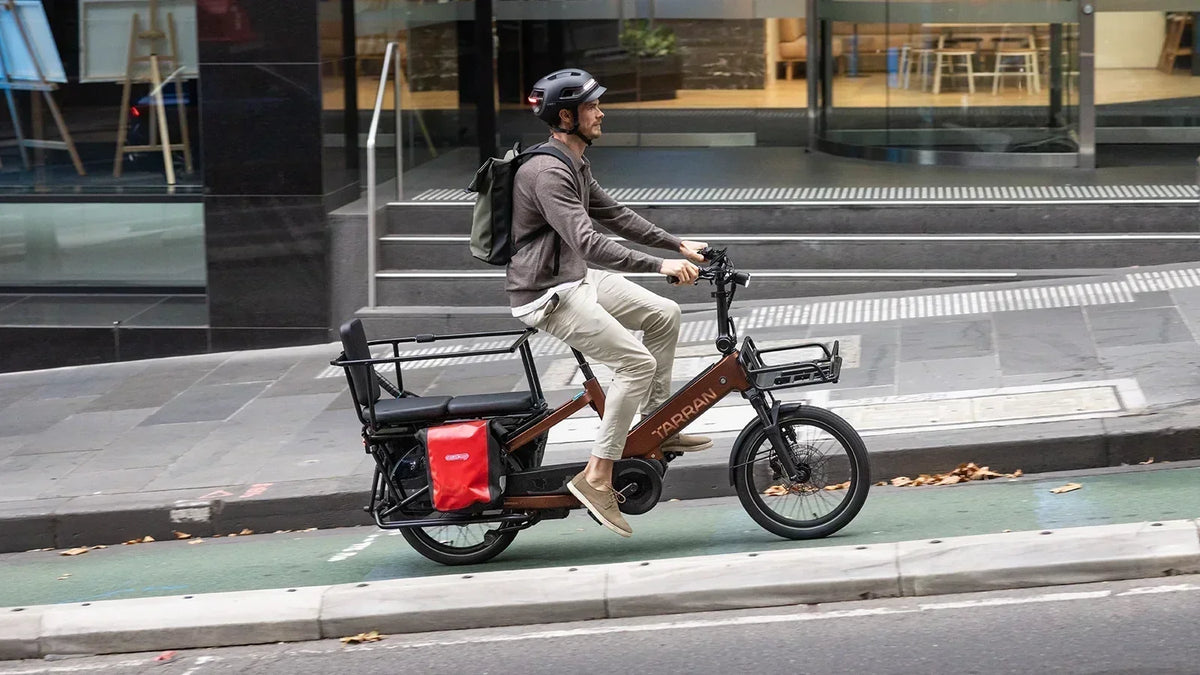
A cargo bike takes up more space than a normal bike. The StVO does not contain an express general ban on parking bicycles on the sidewalk; However, the admissibility does not follow from an express sidewalk parking permit, but from case law and remains tied to the duty of consideration. The specific stopping, parking and signage rules also apply at the edge of the road and in suitable parking areas.
In practice this means: First it must be clarified whether the vehicle is still legally considered a bicycle. The location, disability, traffic signs and local regulations then decide whether the chosen place is permitted. The following sections separate these levels and show which on-site testing really helps.
Can Cargo Bikes Be Parked on the Sidewalk?
The StVO does not expressly allow ordinary bicycles to be parked on sidewalks, but does not contain a general ban on this either. The Higher Administrative Court of Hamburg, decision of June 19, 2009 - 2 Bs 82/09, deduces from this that the sidewalk parking ban for bicycles resulting from Section 12 Paragraph 4 Sentence 1 does not apply. Parking remains permissible only as long as Section 1 Paragraph 2 of the StVO is adhered to: Others may not be harmed, endangered, hindered or harassed, provided this is avoidable.
The VG Braunschweig, judgment of January 25, 2005 - 5 A 216/03, also confirms that Section 12 of the StVO does not result in a general ban on parking bicycles on sidewalks or pedestrian areas. This case law is not an unrestricted parking permit: a bike that practically displaces the intended pedestrian traffic or is set up primarily for a purpose other than later onward travel can be assessed differently.
In practice, a position parallel to the house wall is often cheaper than across the sidewalk. The handlebars, the stand and an open box must not protrude into the running or movement area. Private areas in front of shops or residential buildings can only be used with permission; in public areas, municipalities can control things more closely through effective traffic signs, road regulations or concrete hazard prevention.
A sidewalk space must be assessed from the perspective of the people who actually use it. In addition to the pure remaining width, movement areas in front of doors, ramps, mailboxes and house entrances also count. A cargo bike that allows a walking person to pass can already be an obstacle for a wheelchair or stroller. The turning area at a crossing point is also practically part of the sidewalk. If you turn the box towards the wall of the house and don't let the handlebars or stand protrude into the walkway, you reduce conflicts, but you still have to check whether the entire usable corridor remains clear.
The following areas must remain completely clear:
- Guide strips for the blind and attention fields
- House entrances, ramps and door movement areas
- lowered curbs and crossing points
- Stop areas and necessary waiting areas
In apartment buildings, the private level also applies. House rules, escape routes and fire protection can exclude parking in the stairwell or in front of an entrance. An inner courtyard can only be used with consent and in a designated area. The basic road traffic law rule therefore replaces neither local regulations nor private law requirements.
Important for fast e-cargo bikes: A Pedelec with pedal assistance up to 25 km/h is basically treated like a bicycle. An S-Pedelec with support up to 45 km/h, on the other hand, is a motor vehicle; The sidewalk case law developed for ordinary bicycles cannot be transferred to this. The ADAC comparison of Pedelec and S-Pedelec explains the different legal classification. In case of doubt, it is the vehicle documentation that decides, not the colloquial term “e-bike”.
When Is Parking at the Curb Allowed?
Cargo bikes are generally allowed to park on the right side of the road or on a sufficiently paved right shoulder. Section 12 Paragraph 4 of the StVO specifies the right side of the road as a regular parking location for vehicles. This position is open to bicycles; Anyone who chooses it is subject to the general stopping and parking bans of Section 12 StVO.
The exact basic rule is in Section 12 StVO. Before and behind intersections and junctions, 5 meters must always be kept clear from the intersection of the road edges. If there is a built cycle path to the right of the road in the direction of travel, 8 meters apply before the intersection or junction. In addition, there are no stopping areas, narrow or unclear places, lowered curbs, property entrances and fire brigade entrances.
Section 17 Paragraph 4 Sentence 4 of the StVO applies to bicycles parked on the road: Vehicles that can be easily removed from the road - including bicycles - may not be left unlit in the dark. In practice, this means either a location where the street lighting makes the bike clearly visible from a sufficient distance, or its own identification. Bicycles left on the sidewalk are not subject to this regulation; Section 1 paragraph 2 StVO remains the standard there.
Alignment is important at the edge of the road. The cargo bike is as parallel as possible to the road and so close to the edge that it does not unnecessarily restrict the flow of traffic. At the same time, it must not protrude into a cycle lane, protective lane or the door zone of a vehicle parked directly next to it. For a wide tricycle, a marked parking bay may be more suitable than a narrow remaining area. Visibility is particularly important on roads with high parking pressure because a low cargo bike between delivery trucks can be late to be seen by approaching drivers.
The intersection distances are measured from the imaginary intersection of the road edges, not from the sign or the start of a curb curve. If you cannot estimate the distance with certainty, choose a parking position further away. This protects the visibility of turning vehicles, cyclists and people crossing the street.
At events or construction sites, mobile signs can temporarily cancel an otherwise usual parking option. If you are traveling for several days, check announced stopping bans and local notices. A cargo bike cannot always be moved by a third party at short notice due to its weight and lock. For longer periods of time, a private, covered and lockable room is usually safer than the side of the road.

This brief overview will help you check a possible roadside space:
|
Checkpoint |
Suitable condition |
|
position |
On the right, space-saving and outside of cycle traffic areas |
|
view |
Visible early and not in the intersection or access area |
|
Length of time |
No time limit or temporary order violated |
What Rules Apply in Car Parking Bays?
In principle, a marked public parking area may also be used by a cargo bike, provided that an additional sign does not reserve it for a specific type of vehicle. The bike must be within the marking to save space. However, an additional sign with a car symbol can restrict its use.
When it comes to paid car parking spaces, the practical legal situation for bicycles is not uniform. Signage may impose a fee or time limit, but many parking systems are tailored to motor vehicles with license plates. Whether and how a bicycle should visibly attach a parking ticket or register it digitally varies from location to location. There is no nationwide reliable standard solution for this.
On a cultivated area, the traffic sign counts first, then the additional signs and only then the marking. A blue P alone can indicate a general parking option; An additional sign can limit it to cars, residents, delivery traffic or certain times. For a cargo bike, the size of the parking space is not the decisive evidence. If you ignore the additional sign, you may park incorrectly despite being in a clean position within the lines.
If the local regulations or the digital process cannot be clearly used for bicycles, it is not recommended to enter a license plate number improvisedly. A designated bicycle or cargo bike parking space is more practical and legally secure. Anyone who still needs to use a managed car parking area should clarify the requirement with the operator or the municipality and document the signage on site.
The operator's conditions apply at train stations and stops. A cargo bike does not belong in front of elevators, ticket machines, stairs or escape routes. Ordinary double-decker parkers are often unsuitable due to weight, width or wheelbase. Ground-level bars with sufficient side space are better, as long as the bike remains completely within the parking zone. When combining with the train, you should check in advance whether it is even permissible to take the specific cargo bike with you; a parking space at the train station does not guarantee transportation.
Charging stations are not general long-term parking spaces. If an area is expressly intended for charging e-bikes, it should only be used during the actual charging process. The charger and cable must not create a tripping hazard and must be suitable for the location, mains voltage and weather conditions. The battery is only charged according to the model instructions. A socket in someone else's hallway or business may not be used without permission.
How Much Clear Width Must Remain?
There is no nationwide uniform number that guarantees that every cargo bike parked on every sidewalk is legal. What matters is whether the specific passageway can continue to be used safely and without unreasonable avoidance. Municipal planning dimensions of around 1.80 meters or more can provide guidance, but do not replace the assessment of the site.
Width alone is also not enough: guide strips, door areas, bicycle racks, tree discs and the visibility at junctions change the usable area. If there is only a narrow gap or two people have to move out of the way one after the other, a parking space on the side of the road or a designated cargo bike area is usually the better choice.
The frequently mentioned number of 1.80 meters comes more from planning and accessibility contexts than from a blanket nationwide parking rule for bicycles. Local authorities can set broader standards, especially on heavily used sidewalks. For users, this means: Don't look for a supposed guarantee with a ruler, but rather look at the real range of motion. Encounter traffic, alternative areas and the breadth of mobility aids are more meaningful than a single number without context.
Temporal changes also play a role. A quiet sidewalk in the evening can be a walk to school in the morning; Outdoor dining and a queue grow in front of a café; Garbage cans narrow the passage on collection days. If you leave the cargo bike parked for a longer period of time, you should consider its expected condition throughout the entire parking period. A place that only works when it is parked is unsuitable for standing for several hours.
How Can You Protect the Bike When Parking on the Street?
A place that is permitted by traffic law is not a good protection against theft. The frame and a fixed wheel belong to an immovable bracket with a high-quality lock. A second lock with a different locking technology increases the effort for thieves; Loose batteries, displays and bags are included if the device is not used for a longer period of time.
The bike is more stable if the surface is level and the stand folds out completely. Children should not be left unattended in the box or on the rear when parked. Loose straps, bags and covers are stowed away so that they do not get caught in spokes or protrude into the sidewalk.
When connecting, a long lock does not automatically provide better protection. It should tightly connect the frame and a load-bearing, firmly anchored bracket so that there is little room for lever tools. A second lock secures the other wheel or the valuable transport box. Quick releases on the saddle and wheels increase comfort, but also make disassembly easier. For regular street parking, bolted axles or additional security are worth considering.
Electronic tracking complements, but does not replace, mechanical protection. A GPS signal can help you find something again, but it doesn't prevent it from being transported away. Personal location data belongs in a privacy-conscious app configuration, and an alarm function should be set so that normal movements on the public hanger do not constantly trigger false alarms. It is better not to leave the battery and removable display on the bike if the bike is not in use for a long time, unless the model instructions specify that they should be removed.
This short order helps when choosing a parking space:
- First, read signs, additional signs, and markings.
- Then check the sidewalk, entrances and sight lines for free passage.
- Then align the cargo bike in a stable and space-saving manner.
- Finally, secure the frame and wheel to a sturdy bracket.
Find a Secure Parking Solution
A good parking space is legally comprehensible, leaves enough space for pedestrians and protects the bike from tipping over and theft. For everyday use, it is worth saving suitable brackets or designated cargo bike areas at regular destinations in advance. This makes on-site decisions easy, without having to go through the same test routine several times.
For the TARRAN L1 series, model-specific stand solutions support a stable stand. You can check which dimensions and equipment fit your own parking space during a test drive using the TARRAN dealer search.
Note: This post provides general guidance and not legal advice. The current legal situation, the signage and the requirements of the responsible municipality or the area owner are decisive.
FAQs about parking cargo bikes
Does a Cargo Bike Need a Ticket in a Paid Parking Space?
That depends on the local arrangement and the practically usable payment system. Because parking permit and app procedures are often tailored to motor vehicles, a designated bicycle parking space is a more reliable choice if the regulations are unclear.
Can a cargo bike be connected to a street sign?
This depends on the location and local requirements. The connection must not damage the sign or block the sidewalk, view or access.
Is parking allowed on the bike path?
No. Cycle lanes and constructed cycle paths must remain free for cycle traffic; A parked cargo bike can force others to move into motor traffic.
Can a cargo bike be left on the side of the road overnight?
Yes, provided that there is no stopping or parking ban at the location and the bike is sufficiently visible to other road users in the dark. A safe, lit location and a fixed connection point are particularly important.
Are there special parking spaces just for cargo bikes?
Yes, some municipalities designate their own parking areas for cargo bikes. On-site signage determines which vehicles are allowed to use the area and whether additional time or fee rules apply.

Leave a comment
This site is protected by hCaptcha and the hCaptcha Privacy Policy and Terms of Service apply.