

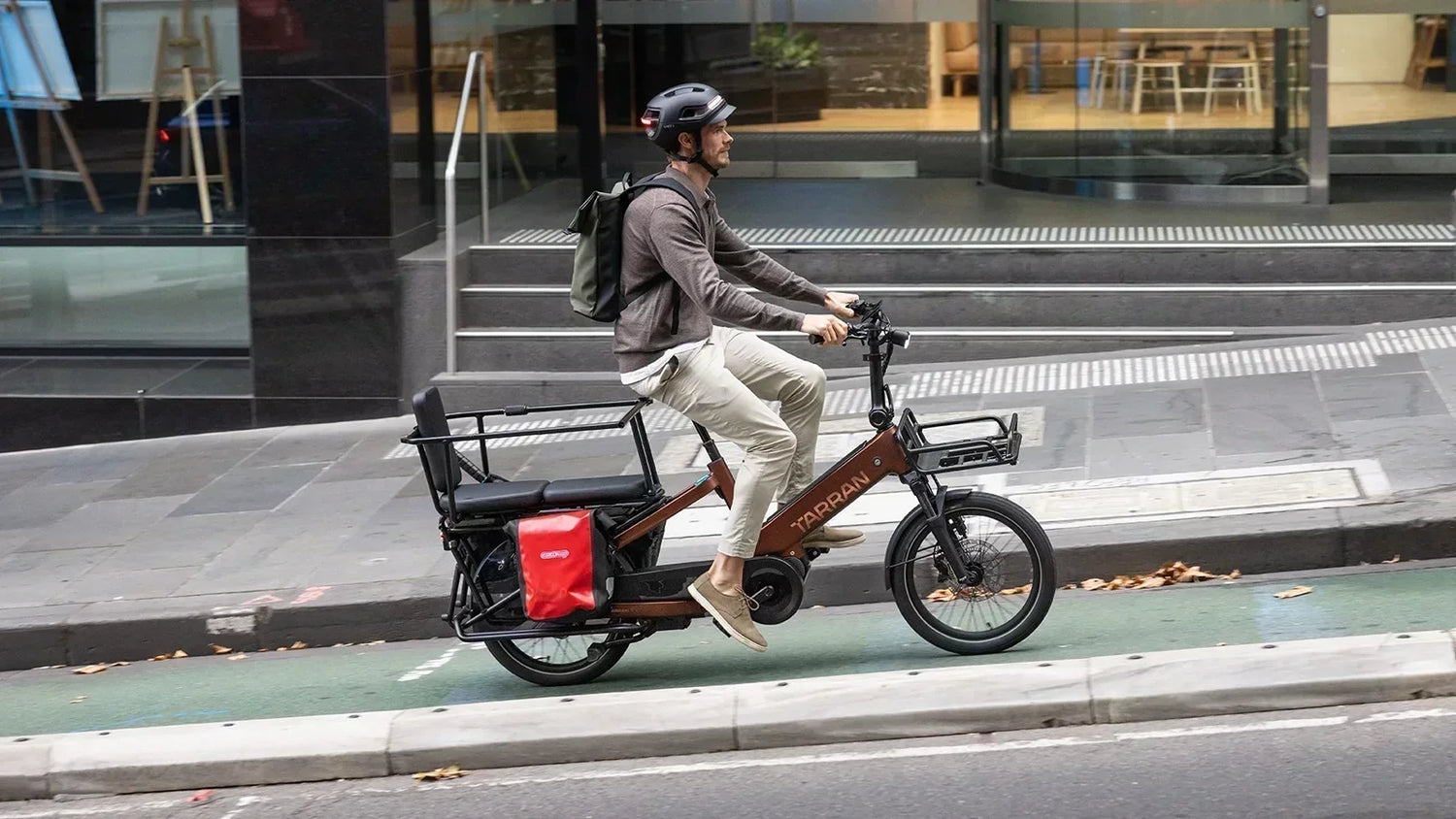
A delivery van stuck in traffic and a fruitless search for parking are everyday realities for many businesses operating in urban delivery. This is exactly where a cargo bike can offer a practical alternative or supplement: on recurring routes with many stops, small to medium-sized shipments, and difficult parking situations, it saves time and can potentially reduce delivery costs.
What matters is not pure riding speed, but the total delivery time, the full cost per job, and whether payload capacity, range, the charging process, and operational organisation all fit together.
Which Tasks a Cargo Bike Can Sensibly Take On in a Business
A cargo bike is better suited as a supplement or for specific routes than as a blanket replacement for every delivery van. Short to moderate urban routes with many stops are good test conditions. Long, irregular routes as well as heavy or bulky freight often favour a delivery van or a mixed solution. A micro-depot can also make sense when the main route is handled differently.
Route Profiles with High Cargo Bike Potential
The greatest potential usually lies with plannable multi-stop routes where searching for parking, traffic congestion, and short walks between vehicle and destination regularly cost time. The DLR study on suitable deployment profiles describes recurring transport tasks as particularly worth examining.
| Route Profile | Good Prerequisites | Key Checkpoint |
| Many urban stops | Small to medium shipments, frequent parking searches | Total delivery time including handover |
| Short distance with high load | Plannable route and suitable transport box | Weight, volume, and secure loading |
| Long or irregular route | Few stops, changing destinations, or large quantities | Delivery van or mixed fleet as comparison |
A cargo bike in business operations can also be combined with a micro-depot or fixed handover point. This means the cargo bike does not have to cover every long approach route, but can focus on the last mile.
Manual Cargo Bike or E-Cargo Bike
A manual cargo bike is more suitable for light loads, short distances, and low daily output. An e-cargo bike should be assessed separately when load, gradients, route length, or a tight time window have a greater influence on physical effort and speed. The decisive factors are the specific vehicle data and route profile, not a general range figure.
Before selecting, therefore, record the weight of goods, containers, and tools, as well as daily kilometres, gradients, stops, and possible recharging times. With high payloads or bulky freight, a delivery van often remains the more practical solution.
When Time and Cost Advantages Actually Arise
An advantage arises primarily when a delivery van on the reference route is regularly held up by traffic, parking searches, detours, or long walks to the destination, and the full costs of the cargo bike per job are lower. Without your own operational data, no general saving in euros and no fixed payback period can be stated reliably.
Recording Time Savings per Route
Compare the same route using both modes of transport under as similar traffic and working conditions as possible. For the last mile, what counts is the total delivery time, meaning the journey, parking search, parking, handover, and return to the vehicle. This exact breakdown is also highlighted in the technical guide on cargo bike transport in city logistics.
- Select a representative route with a real load.
- Record journey time, stops, parking search, handover, and return separately.
- Note disruptive factors such as construction sites, weather, or unusual waiting times.
- Repeat the comparison on several comparable working days.
A cargo bike is therefore not fundamentally faster than a delivery van. On suitable urban routes, it can save time when the elimination of parking searches and long walks outweighs the pure journey time.
Comparing Costs per Job
Do not calculate only the purchase price or energy costs. A fair comparison uses the same assumptions for personnel costs and utilisation, and sets the full costs per job or route against each other. The guide on integrating cargo bikes into everyday business operations recommends looking at the specific route including traffic and parking situation.
| Cost Factor | Check for Cargo Bike | Check for Delivery Van |
| Working time | Route and handover time | Driving, parking, and delivery time |
| Running costs | Energy, maintenance, insurance | Fuel, maintenance, insurance |
| Infrastructure | Charging point and parking space | Parking space, parking, and toll costs |
| Risk | Breakdown, replacement vehicle, utilisation | Breakdown, replacement vehicle, utilisation |
Compare the costs of a cargo bike not in isolation, but per job actually completed. This makes it visible whether a time advantage is also economically relevant, or whether it is cancelled out by low utilisation, additional handovers, and downtime costs.
Which Operational Conditions Need to Be Clarified Before Starting
Before starting, the vehicle and daily schedule must fit together. Payload, storage space, range under real load, charging and parking facilities, maintenance, replacement mobility, insurance, and driver deployment all belong in a joint operational plan.
Matching Payload, Load Volume, and Range
Assess the total weight of goods, containers, tools, and the rider together. Also check whether the usable load volume is sufficient for the largest typical shipments, and whether the daily range is adequate given stops, gradients, weather, riding style, and recharging times.
- Document weight and volume per job
- Record route profile and number of stops
- Realistically plan for recharging during the shift
- Check dimensions at doors, ramps, lifts, and handover points
When making the specific selection, also check how heavy loads can be transported safely. However, this information does not replace specific load or safety guarantees for a particular model.
Organising Charging, Parking, and Maintenance
Organise the process before the pilot based on these points:
- Protected charging point and secure parking space
- Person responsible for battery, keys, and charging process
- Maintenance plan and documented responsibility in the event of defects
- Replacement vehicle or alternative process for routes that break down
Cargo bike accessories can serve as guidance for equipment, but alone say nothing about suitability for your route.
Checking Insurance and Driver Deployment
Clarify insurance cover, operational usage rules, and required briefings before starting, with your insurer, a relevant specialist body, and the manufacturer's documentation. Requirements may depend on vehicle type, usage, and contract terms. A blanket statement on insurance or driver qualifications would therefore not be reliable.
Which Industries and Business Models Are Particularly Worth Examining
The assessment is worthwhile for delivery services, catering, retail, trades, and mobile services, provided the respective route and load profile fits. The industry alone does not determine suitability. What is relevant is the load profile, route length, stop frequency, time windows, and parking conditions. This is also shown in the overview of commercial applications for cargo bikes.

Evaluating Typical Commercial Deployment Scenarios
| Deployment Scenario | Good Prerequisites | Typical Limitation |
| Delivery services and catering | Many short handovers, plannable areas | Large or temperature-critical quantities |
| Retail and branch logistics | Regular routes between warehouse and branch | High unit numbers or long distances |
| Trades | Tools and smaller material quantities | Heavy building materials, bulky parts |
| Mobile services | Customer appointments in dense urban areas | Changing, distant deployment locations |
For use in delivery services, what counts is not the industry label but the specific route. With large quantities of goods, long distances, or changing deployment locations, a mixed fleet is often more realistic than completely replacing the delivery van.
Planning a Single Vehicle or Small Fleet
- Start with a clearly defined pilot and one responsible person.
- Document actual stops, payload, route duration, costs, and breakdowns.
- Evaluate the data before procuring multiple vehicles.
- Decide which routes will be permanently covered by the cargo bike, supplemented by a mixed fleet, or continue to be driven with the delivery van.
A commercial cargo bike can prove itself as a single vehicle while other routes continue to be driven with the delivery van.
Classifying Advertising as an Additional Benefit
Visible vehicle branding can offer an additional communication benefit on daily routes. However, it is neither proof of economic viability nor a guaranteed advertising success. The transport task, full costs, and everyday practicality must be convincing independently of this.
Clarifying Tax, Organisation, and Responsibilities Before Purchase
Before buying or leasing, the form of procurement, operational allocation, possible private use, contract terms, and internal responsibilities should be clarified. The tax treatment depends on the individual case. Specific legal consequences or advantages should be discussed with your tax advisor before signing any contract.
Classifying Purchase, Leasing, and Ongoing Operating Costs
| Procurement Route | Worth Examining When | Clarify Before Signing |
| Purchase | Long-term use and available liquidity | Total costs, maintenance, warranty, and replacement |
| Leasing | Desire for a plannable term or lower initial outlay | Mileage limit, return, maintenance, and total costs |
| Mixed fleet | Different route profiles in the business | Usage rules, utilisation, and responsibilities |
Compare usage period, expected mileage, maintenance, flexibility, and total costs. A blanket tax advantage of buying versus leasing should not be derived from this.
Documenting Business Use
Document before starting:
- Handover of the vehicle and management of keys and battery
- Driver changes, routes, and business or private use
- Damage, maintenance, and responsibilities
- Clarification of outstanding tax and insurance questions
Business and private use should be documented separately and coordinated with your tax advisor. For the specific vehicle selection, criteria for an e-cargo bike can be helpful. They do not replace a tax or insurance review.
Reaching a Purchase Decision with a Reliable Checklist
A reliable decision comes from a specific reference route with a real load, a fair comparison with a delivery van, and a prepared operational process. The practical test is a decision-making aid, not a guarantee of success. The DLR materials on commercial deployment can serve as guidance.
- Select a suitable route: Choose a recurring urban multi-stop route with a representative load.
- Record load and route data: Document weight, volume, kilometres, gradients, stops, time windows, and parking options.
- Calculate the delivery van comparison: Compare the total delivery time and full costs per job with a delivery van route that is as similar as possible.
- Prepare operations: Check charging point, parking space, maintenance, replacement mobility, responsibility, and driver deployment.
- Coordinate with specialists: Involve your insurer and tax advisor, and regulate business and private use in writing.
- Evaluate the pilot: Take into account multiple drivers, seasonal differences, breakdowns, and maintenance. Then decide between a single vehicle, mixed fleet, further scaling, or abandoning the idea.
If the data consistently supports the cargo bike, you can then check suitable load carriers or browse transport accessories. Without a reliable practical test, the purchase decision should remain provisional.
Commercial Cargo Bike Pilot FAQs
The following questions concern procurement, operation in bad weather, private use, and the most important metrics in the pilot. The answers do not replace an individual tax or insurance review.
Can a business lease a cargo bike instead of buying one?
Yes, both routes are generally possible. Compare term, mileage limit, maintenance, return conditions, and total costs. The tax treatment should be examined separately.
How can a cargo bike be used in bad weather?
Plan protection for goods and the rider, as well as an alternative route or a substitute vehicle. Document how weather affects loading time, handover, and breakdowns.
May an employee use a commercial cargo bike privately?
This should be explicitly regulated and documented. Record private journeys as well as responsibilities for damage and maintenance. Possible tax consequences must be examined on an individual basis.
What data should a business measure during the pilot?
Record route duration, journey and stop times, parking searches, handovers, jobs, payload, charging effort, breakdowns, maintenance costs, and cost per job. Compare the figures with a similar delivery van route.


Leave a comment
This site is protected by hCaptcha and the hCaptcha Privacy Policy and Terms of Service apply.