

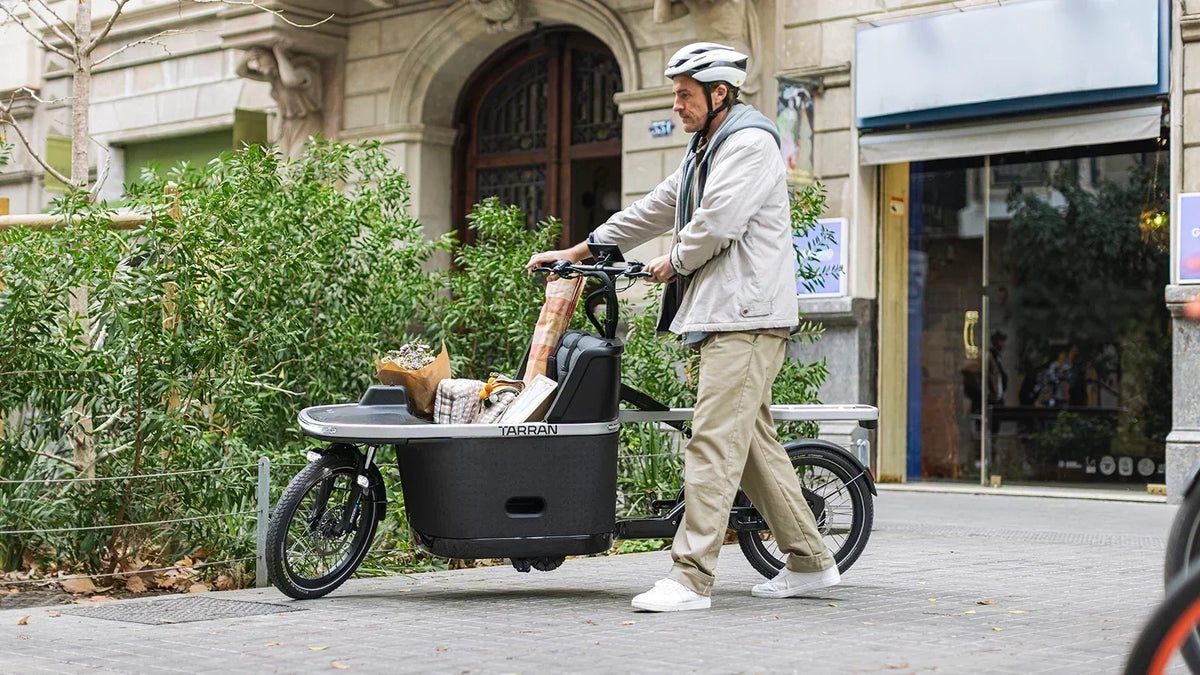
Parking a high-quality cargo e-bike requires more than just trust. It calls for a three-stage security concept made up of solid mechanical protection, intelligent tracking and alert alarms. Each layer costs the thief time — and in public spaces, time is the most important factor.
This is especially true for a cargo e-bike. The purchase price is often in the range of a small car, while a cargo bike’s length often makes it harder to lock up in the same way as a normal bicycle. The following text explains which type of protection suits which parking situation, where the frame should actually be locked, and what tracking can realistically achieve. The focus is less on product names and more on understandable everyday decisions.
Why is a single lock rarely enough?
A single lock usually protects only against opportunistic thieves. Anyone working with suitable tools needs less than a minute for many locks, and a cargo e-bike is a worthwhile target. Two different types of lock force the thief to carry two tools and attack the bike twice.
The Police Crime Prevention Programme of the Federal States and the Federal Government recommends solid U-locks, chain locks or folding locks of tested quality and points out that spoke locks alone are not sufficient. Thin cable locks or lightweight U-locks can be opened with simple tools. The commonly cited rule of thumb of investing around five to ten percent of the purchase price in security quickly leads, for a cargo bike in the four-digit price range, to a budget that is enough for two good locks.
Size is another factor. Depending on the model, a cargo bike weighs between around 30 and 70 kilograms. This makes carrying it away much harder, but it does not prevent the bike from being loaded into a van as long as it is standing freely. That is exactly why connection to a fixed object is more important than the question of which lock is the most expensive.
A sensible solution is a combination of a long lock for securing the bike to an object and a short, hard-to-attack lock directly on the frame. Both should be positioned as far from the ground as possible, so that bolt cutters cannot be supported against the floor.
An everyday example makes the difference clear. If you leave your cargo bike at the station in the morning and only close the frame lock, you leave behind a vehicle that two people can lift and push onto a loading platform within seconds. If the same bike is connected to an anchored stand with a folding lock, the thief has to work on the object, visibly and noisily. That difference matters more often than whether a lock cost eighty or one hundred and fifty euros.

Where should the frame be locked?
The frame belongs on an object firmly anchored in the ground, not just on one of the bike’s own wheels. The police expressly advise locking the frame as well as the front and rear wheels, because a blocked wheel does not prevent a bike from being carried away or loaded into a vehicle.
With a front-loader, this is more challenging than with a city bike. The cargo box sits between the handlebar and the front wheel, meaning the main frame is often farther away from the bicycle stand. In practice, three approaches work: locking the bike at the down tube or the frame tube behind the box, locking it at the rear triangle if the bike is parked backwards against the stand, or using a longer chain lock that loops around the box and the stand.
What you should check at the location before locking up:
- Is the stand really anchored in the ground, or is it only screwed down and easy to loosen?
- Are there cutting marks on the stand that have been hidden by stickers or vegetation?
- Is the location visible, or is it in a niche without public traffic?
- Is there enough room so that the frame is not merely hanging loosely in the lock?
A construction fence, a loose railing or a post without a closed top are not anchor points. If there is nothing suitable on site, it may be the better decision to ride a few metres further to a guarded parking facility. For private areas, floor anchors in a basement, garage or carport are suitable, because high-value bikes are stolen there as well.
What can GPS and motion alarms do?
Tracking does not prevent theft, but it improves the chances of recovery and gives the police a concrete starting point. A motion alarm works one step earlier because it notifies you while the bike is still near you. Both functions complement mechanical protection; they do not replace it.
A look at clearance rates shows why this is useful. According to the 2025 Police Crime Statistics of the Federal Criminal Police Office, the number of bicycle thefts declined in 2025. Despite the decrease, bicycle theft remains a relevant risk. For the same year, the German Insurance Association reports around 214,300 police-recorded bicycle thefts and compensation payments of about 150 million euros. Without your own trace, you therefore have little to work with after a theft.
When choosing a tracking solution, it is worth looking at three points. First, the power supply: a tracker connected to the vehicle battery stops working as soon as the battery is removed, whereas a module with its own backup battery continues transmitting for longer. Second, the connection: pure Bluetooth trackers usually provide a location only when a compatible device in a network is within range. LTE-based systems can transmit data even without third-party devices nearby, provided there is mobile reception. In underground garages, basements, containers or shielded storage halls, however, tracking may be limited. Third, ongoing costs, because mobile modules usually require a tariff.
With branded models that have factory-integrated technology, retrofitting is not necessary. The TARRAN T1 Pro by Tarranbike is one example: according to the manufacturer, the cargo bike has an integrated GPS tracker with location tracking via the TARRAN app, app-based anti-theft protection and two NFC keys included. The connection is made via an LTE module with one year of free LTE data use; according to the manufacturer, a subscription is required for continued use of LTE functions. Regardless of the system, note down the frame number, brand and type, and have the bike coded. Without this information, a recovered bike often cannot be assigned to its owner.
How do you protect the battery and display?
Not only the entire bike, but also particularly desirable individual parts are targeted by thieves — above all the battery. The battery is the component with the best ratio of value to portability, which is why it is often stolen separately. The easiest approach is to take it with you if it is removable. If that is not practical, secure it additionally, because the standard battery locks on many bikes are generally not considered sufficient anti-theft protection.
For the T1 Pro, the 708 Wh battery is internally installed and removable according to the manufacturer; a second battery is optionally available. Removable batteries have a second everyday advantage: they can be charged in the apartment instead of in the bicycle cellar, which is gentler on the cells in frosty conditions.
Displays and cockpits can be protected in different ways. Removable displays belong in your bag; permanently installed systems are less interesting to thieves because they are hardly usable without the corresponding bike. It also makes sense to remove everything loose before parking — such as the rain cover, seat cushions, panniers and child seat belts. These parts are rarely insured and can be surprisingly expensive to replace.
A brief note about the cargo box: if you leave shopping in the bike for a short time, choose a visible location. An open box is an invitation, and theft from the box is often assessed differently by insurers than theft of the bike itself.
A fixed routine has proved practical because it works without much thought: remove the battery, take the display with you or cover it, empty the box, and only then lock the bike. If you always keep this order the same, you are less likely to forget a step, especially when children are with you and things have to move quickly. On bikes with an electronic lock, the time required is low anyway, because locking when leaving happens automatically or by key card.
Which protection suits short and long stops?
The answer depends less on the bike than on duration, surroundings and visibility. A stop at the bakery with the bike in sight requires something different from eight hours at the station. The following classification has proved useful as guidance, but it does not replace assessing the specific situation on site.
|
Stop duration |
Sensible basic protection |
Additionally recommended |
|---|---|---|
|
Up to about 5 minutes, with visual contact |
Frame lock or app lock |
Visible location with public traffic |
|
15 to 60 minutes, city centre |
U-lock or folding lock on the frame and an anchored object |
Take the battery with you, leave GPS tracking active |
|
Several hours, workplace |
Two different types of lock |
Motion alarm, parking in a monitored facility |
|
Overnight, public space |
Avoid if possible |
If unavoidable: two locks, floor anchor, check insurance cover |
|
Basement or garage |
Floor anchor plus sturdy lock |
Coding, documented frame number |
Two points are often underestimated. Anyone who regularly parks in the same place becomes predictable, which makes planning easier for thieves. And a lock that is awkward to handle will eventually no longer be used for short stops. A frame lock or electronic lock that works without bending down increases the likelihood that the bike will be locked at all.
For longer absences, it is worth checking your insurance cover. Many policies require a lock of a certain security class and exclude night-time parking in public spaces. Check these conditions before relying on the cover, because the required proof can no longer be provided afterwards.
How to build up theft protection step by step
If you are starting with a limited budget, the following order has proved useful:
- A solid U-lock or folding lock, long enough for the frame and anchor point
- A second lock of a different type for the remaining wheel
- Document the frame number and have the bike coded
- Set up tracking and motion alarm and test the notifications
- Take the battery with you or secure it separately
- Compare insurance conditions with the actual parking situation
If you are planning a new cargo bike, it is worth comparing the factory-integrated security functions with possible accessory solutions. At TARRAN, you can find both integrated security functions and suitable accessories. A test ride also helps you assess handling in everyday use.
Cargo E-Bike Security Questions Answered
Is a frame lock enough for a cargo e-bike?
No, except for very short stops within sight. A frame lock only blocks the wheel and does not prevent the bike from being loaded into a vehicle. For anything beyond that, the frame should also be locked to an anchored object. Front-loaders often require a longer lock for this than a city bike.
Do I also need to lock my cargo bike in the basement?
Yes, if several parties have access. The police point out that high-value bikes are also stolen from basements and garages. A floor anchor combined with a sturdy lock is the most practical solution there. Also check whether your insurance has its own requirements for basement rooms.
Does GPS tracking work without a mobile connection?
That depends on the technology installed. Systems with a mobile module send locations independently, while pure Bluetooth solutions need another device nearby. For models with an LTE module, check the relevant manufacturer information to see whether a tariff is permanently required and what it costs.
How much should a lock for a cargo bike cost?
Usually, if you follow the common rule of thumb, around five to ten percent of the purchase price. For a cargo e-bike, this results in a budget that is more sensibly distributed across two locks of different types than spent on a single expensive model. Also pay attention to which security class your insurance contract requires.
Does coding really help after a theft?
Yes, if the bike is later recovered. Coding or a documented frame number allows clear assignment to the owner and makes resale more difficult. Without such identification, a recovered bike often cannot be assigned to anyone. Coding is carried out by specialist dealers and the ADFC, and in some cases also by police advisory offices.

Leave a comment
This site is protected by hCaptcha and the hCaptcha Privacy Policy and Terms of Service apply.