

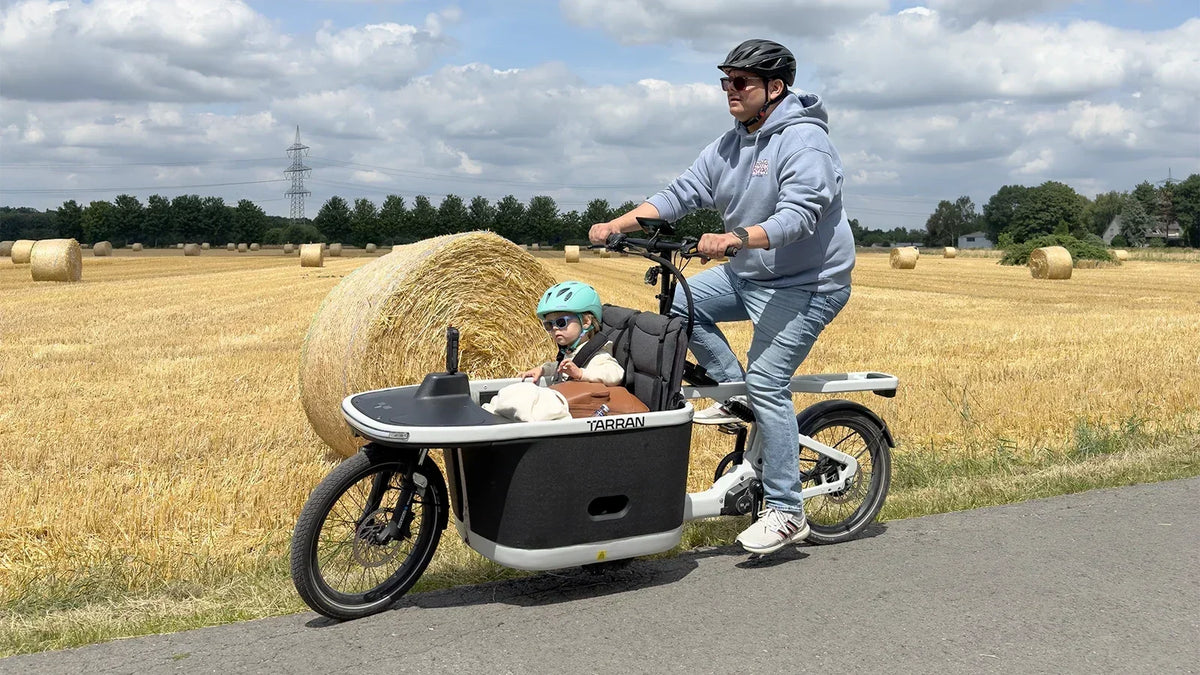
When buying an electric cargo bike, the question of the right battery capacity quickly arises. Anyone who transports heavy loads in everyday life or takes children to daycare needs enough energy to avoid running out of power prematurely. The right battery size for an electric cargo bike depends on daily riding distances, topography, and payload.
What Do Watt-Hours Mean for a Cargo Bike?
Watt-hours, or Wh, describe the total amount of energy a battery can store and form the most important reference value for range. A battery with 500 Wh can theoretically deliver a power output of 500 watts for one hour, or 100 watts for five hours.
In real-world riding with an e-bike cargo bike, however, motor power, assistance level, and total weight have a significant influence on this value. As official expert articles and associations such as the ADFC on bicycle accessories and batteries make clear, usable energy strongly depends on external conditions.
In addition, the age of the cells and the number of charge cycles play a decisive role in actual long-term performance. Modern lithium-ion batteries are subject to natural wear, meaning that the amount of energy they can store decreases after several years of use.
Anyone planning for the long term should factor in this capacity loss and choose a little more reserve capacity when buying, so that sufficient range is still available after several years.
The capacity is calculated by multiplying the voltage in volts, V, by the ampere-hour rating, Ah. In practice, higher watt-hours mean more kilometers of range before the next charge. Anyone using an electric cargo bike in an urban environment benefits from this key figure when planning realistic charging intervals.
A model with 400 Wh is suitable for short commuting routes, while higher capacities from 625 Wh or 1000 Wh provide relief on longer journeys.
How Many Kilometers Do Families Ride Each Day?
Daily trips with a cargo bike often add up faster than expected. The trip to daycare, a subsequent shopping run, and the commute to work quickly add up to distances of 15 to 30 kilometers per day for many families.

In addition to these obvious routes, unexpected detours often occur during the week. A spontaneous stop at the recycling center, a visit to the playground, or trips to various children’s leisure activities can quickly expand the operating radius.
Anyone who calculates too tightly risks the battery running out early and having to move the heavy cargo bike over the last few kilometers without motor assistance.
An electric cargo bike consumes noticeably more energy than a normal city e-bike due to its higher own weight and payload. With an average consumption of 10 to 15 watt-hours per kilometer on flat terrain, a 25-kilometer day already requires a buffer.
If you do not want to charge the battery every day, it is best to plan with a capacity that is sufficient for at least two to three days. This reduces daily effort and prevents the drive system from failing unexpectedly. Independent consumer information on environmentally friendly mobility is also provided by the German Transport Club, VCD.
How Do Hills and Stops Change Consumption?
Topography and riding style have an extremely strong influence on everyday energy demand. Every climb forces the motor to deliver more power, causing the battery level to drop rapidly.
In addition, constant starting at traffic lights and intersections drives up consumption, because the electric motor has to apply the most force when starting from a standstill. Anyone living in a hilly region or riding through many stop-and-go sections should therefore choose a larger battery capacity than riders in flat lowland areas.
The transported weight also plays a direct role. If the load doubles due to children or shopping, the energy demand increases noticeably, even if the route remains flat.
An often overlooked factor is wind strength and direction on flat terrain. Headwind acts like a constant climb on a large-surface cargo bike and forces the rider to choose a higher assistance level for longer periods. In coastal regions or on open commuter routes, this can increase energy consumption per kilometer by 20 to 30 percent.
The following overview summarizes how strongly different everyday conditions influence the energy demand of an electric cargo bike and which battery capacity is recommended as a guideline.
| Everyday Influencing Factor | Typical Additional Consumption / Effect | Recommended Minimum Battery Capacity |
| Flat route, under 15 km/day | Low, constant energy demand, approx. 10–12 Wh/km | 400 Wh to 500 Wh |
| Hilly terrain / climbs | High load current, battery level may drop up to 50% faster | 625 Wh or higher |
| Strong headwind / open fields | Increased continuous resistance, +20% to +30% consumption | 500 Wh to 625 Wh |
| Heavy payload, children + shopping | Significantly higher system weight, strong starting current | 625 Wh to dual battery |
When Is a Removable Battery More Practical?
A removable battery system offers flexibility when the daily route profile varies greatly or when there is no fixed charging option near the parking space. Instead of maneuvering a heavy battery together with the entire bike to a socket, a compact additional battery can simply be removed and charged in the apartment.
Especially for users in apartment buildings without a direct basement connection with power supply, an easily removable second battery is a major convenience. Instead of maneuvering the entire heavy cargo bike into the hallway or basement, only the compact energy storage unit is taken along.
This protects the equipment from theft outdoors and at the same time ensures that the battery can be charged at optimal room temperatures.
For commuters who leave the cargo bike at work during the day, a portable second battery is often the more convenient solution than a single extremely heavy XXL battery. In addition, the lifespan of the system can be increased if the load is distributed across two power sources.
Nevertheless, a removable battery also means higher weight and additional purchase costs, which is why this step should be considered carefully.
When Is a Dual-Battery System Worth It?
An integrated dual-battery system is especially suitable for frequent riders, cargo professionals, and families with very long work or school routes. If daily distances beyond 40 kilometers are covered and the bike is fully loaded, a single standard battery is often not enough in everyday use.
With branded models such as those from tarranbike, the energy supply can be flexibly adapted to actual demand through well-thought-out system integration. A dual battery protects against being stranded halfway through commuter traffic and saves you from constantly carrying the charger.
Anyone who uses the cargo bike commercially or as their main means of transport benefits from this fail-safe equipment.
Another advantage of dual systems lies in the even load on the cells. Since the current demand is distributed across two separate batteries, less current flows through the individual cells on average, which minimizes heat development.
This noticeably protects the hardware and helps ensure that both energy storage units retain their maximum capacity over a longer service life.
Determine the Right Capacity Now
The choice of the right battery size depends on individual routes, transport weight, and charging options. Anyone who knows their daily kilometers and takes topography into account can quickly find the right energy level for their own needs.
Discover the Tarran T1 Pro cargo bike to get to know a modern and powerful concept for urban everyday life.
Cargo Bike Battery Questions Answered
Is a 500 Wh Battery Enough for Everyday Use?
Usually, yes, provided the daily route is under 25 kilometers and the terrain is mostly flat. A battery of this size provides enough reserve in urban environments for smaller errands and the commute to work, as long as you do not ride permanently in the highest assistance level.
However, with heavy payloads or very frequent stop-and-go riding, the capacity can become tight. For this reason, realistic route planning in advance is always recommended.
How Long Does a Cargo Bike Battery Last?
That depends on how often it is charged and how well it is maintained, although modern lithium-ion batteries usually withstand several hundred charging cycles. In practice, this means a service life of several years with proper treatment before noticeable capacity loss occurs.
To maximize lifespan, you should avoid extreme temperatures and ideally neither fully discharge the battery nor store it permanently at one hundred percent charge.
Can a Battery Be Retrofitted Later?
Yes, provided the frame and the manufacturer’s electronic system are compatible with a second battery or a larger model. Many modern cargo bikes offer modular mounts that allow a later extension of range.
However, you should definitely check in advance whether your specific model has been approved by the manufacturer for such modifications in order not to jeopardize warranty claims or the electronic safety of the drive system.
Does Heavy Luggage Increase Battery Wear?
Yes, because the motor draws more current under load, which leads to higher thermal stress on the cells. If the cargo bike is permanently operated at its load limit, the battery cells heat up more strongly, which can accelerate the aging process in the long term.
Anticipatory riding and choosing a moderate assistance level help noticeably reduce this additional wear in demanding everyday use.
Should the Battery Be Stored Indoors in Winter?
Yes. At low temperatures, performance temporarily decreases, which is why storage at room temperature helps preserve range. Cold slows down the chemical processes inside lithium-ion cells, meaning noticeably less energy is available in the short term.
If you insert the battery shortly before riding while it is still at room temperature and do not leave it outside overnight on the cold bike in winter, you help ensure full performance.



Leave a comment
This site is protected by hCaptcha and the hCaptcha Privacy Policy and Terms of Service apply.