

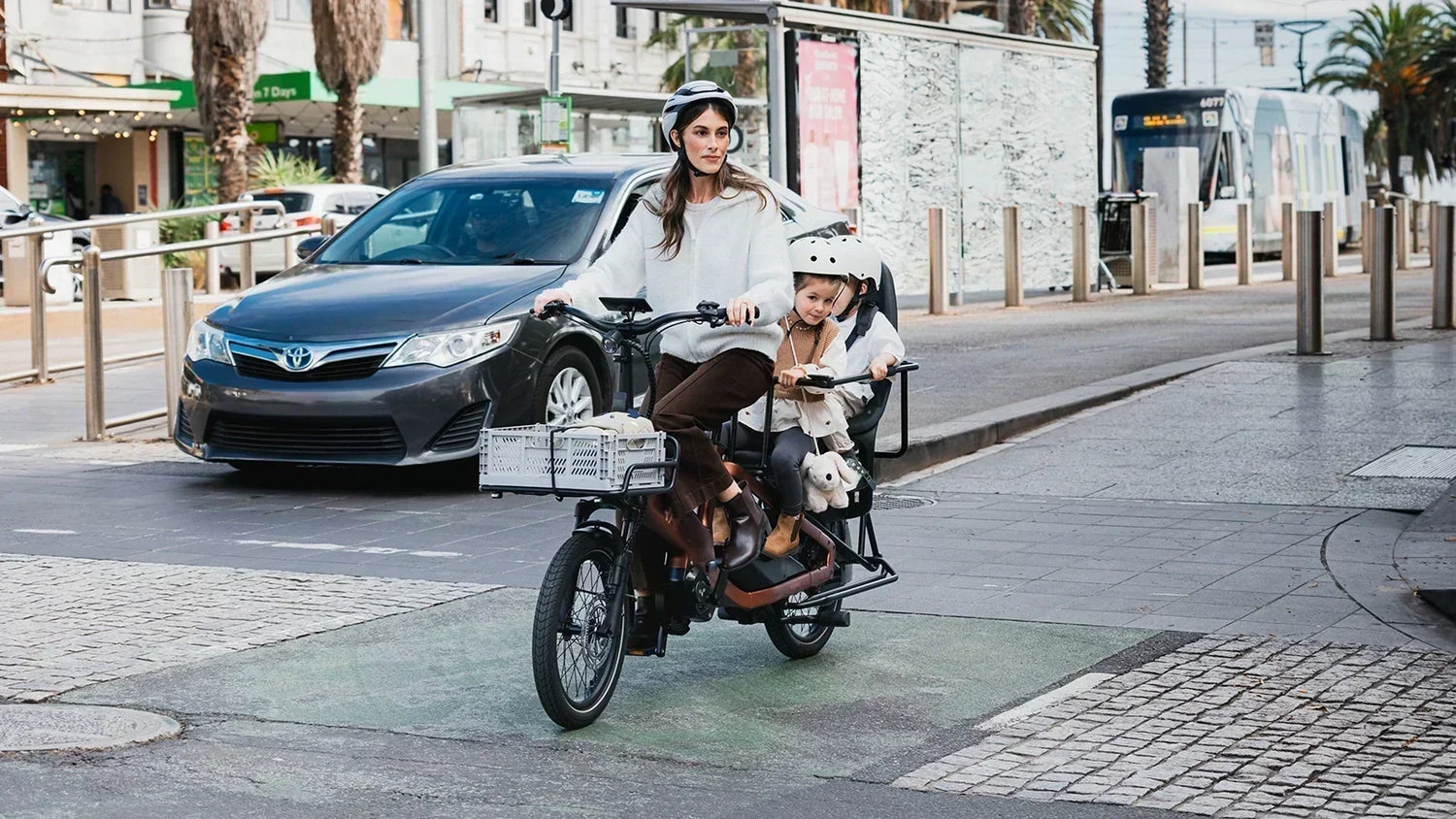
When the sun is shining and the panniers are packed, many parents are itching to get going: the new cargo bike is ready, but what about the youngest family member? From what age can a baby ride in a cargo bike?
The short answer is: there is no fixed minimum age on paper. When your baby is ready for their first trip depends less on the calendar and more on their head and trunk control, the right transport solution, and of course the road conditions. This guide explains what you need to consider when making this decision and when a conversation with your pediatrician makes sense.
Is Your Baby Ready for the Cargo Bike?
A specific month alone is not enough to make this decision. Developmental stage, health considerations, transport solution, and manufacturer specifications must all align. Particular caution is warranted with very young babies. The ADFC mentions push mode and short distances as a cautious guideline for very young babies, but does not derive any medical clearance from this.
Pay attention to observable prerequisites: Can your baby hold their head up securely on their own? Is the trunk sufficiently stable for the intended position? Are there any health reasons that argue against vibrations, a particular posture, or longer rides? These questions can only be answered individually and, where necessary, with professional advice. A baby seat or adapter does not replace this assessment.
For an initial trial run, choose a short, familiar, and ideally flat route with little traffic. A trip to the pediatrician's office or the supermarket should not be the first test under time pressure. Longer distances, confusing intersections, and bumpy roads only come into consideration once child and system have functioned smoothly together on a short route.
Which Transport Solution Suits the Developmental Stage?
A baby seat with an adapter can be an early transport option, but only with an explicitly documented combination of baby seat model, adapter, cargo bike, and mounting. An adapter does not automatically make a seat suitable for the child or for every bike. For children in the transport box, appropriate seats and securely installed harnesses are important checkpoints.
Checking the Baby Seat with Adapter
Before purchasing and before mounting, check not just the brand name. Have the compatibility confirmed in writing for the exact model and then verify the mounting on your own bike.
| Checkpoint | What to compare specifically | If in doubt |
| Baby seat model | Exact model designation and intended installation direction | Do not assume based on a similar seat |
| Adapter approval | Approval for this seat model and this cargo bike | Ask the manufacturer or specialist retailer |
| Mounting | Mounting points, locking mechanism, and complete engagement | Do not mount if one locking point remains open |
| Harness routing | Path without twisting, pinching, or loose sections | Follow the instructions and do not improvise |
| Clearance | Distance to the box, covers, and moving parts | Stop if there is contact or restricted access |
Checkpoints such as size, weight, secure mounting, headrest, leg and foot restraint, and harness routing are relevant for seat solutions. However, they do not automatically confirm the suitability of a baby seat in a cargo bike. Kindergesundheit-info also points this out in its checkpoints for bicycle seats. A suitable baby seat adapter increases comfort but in no way replaces written model approval.

Transitioning from Baby Seat to a Seat Solution
The transition is not determined by calendar age alone, but by whether body control, harness routing, and the specifications of the intended seat solution all align. A seat for older children is not a substitute for a suitable infant solution as long as your baby cannot independently assume the required position.
When transitioning, check the harness routing, body support, clearance, and the size and weight specifications of the respective seat. A child seat with a 5-point harness is only a sensible option when the complete configuration and the child's developmental stage are compatible.
How Much Do the Road Surface and Riding Style Affect the Baby?
Suspension can influence comfort and vibrations on certain obstacles, but does not make any route suitable for a baby. Road surface, tire pressure, load, transport position, braking maneuvers, and speed all interact. An independent ADAC system comparison demonstrates the dependence of suspension effectiveness on the respective system and obstacle. Individual measured values cannot be transferred to every bike or to babies.
Assessing Suspension and Road Surface Together
For a first ride, a flat, short, and low-traffic route is the more conservative choice, regardless of whether your bike has suspension. Avoid curbs, potholes, cobblestones, and abruptly riding over edges. Suspension is a comfort and load factor, but neither an age clearance nor a safety guarantee.
Check the tire pressure and load as specified by the manufacturer. Without specific model information, blanket speed, weight, or load limits would not be reliable. On noticeably uneven terrain, an alternative route is often more sensible than additional accessories.
Adapting Your Riding Style for the First Trip
- Prepare the route: Ride the planned route without the child first and look out for tight spots, edges, gradients, and necessary evasive maneuvers. The ADAC purchasing guide also recommends practice runs without children.
- Ride calmly: Accelerate in a controlled manner, brake early, and avoid sharp evasive maneuvers. The first ride should take place without time pressure.
- Carry out a post-check: After the short trip, check the seating position, harness routing, pressure points, freedom of movement, and observable wellbeing. If you notice unusual behavior, end the ride.
General safety notes on riding with children can supplement your preparation. They do not replace the instructions for infant transport or the verification of the specific configuration.
How Does Weather Protection Work Without Restricting Airflow?
Weather protection only makes sense if it limits wind and precipitation without significantly impairing ventilation, visual monitoring, or quick access. A closed cover is therefore not automatically the better choice. In unfavorable weather, it may be more sensible to postpone the trip rather than adding extra layers or fully closing the cabin.
Assessing Wind, Cold, and Moisture Separately
- Airflow: Ventilation openings must remain clear. Clothing or covers must not block the airways.
- Temperature: Observe the baby's clothing, skin, and behavior during short stops. A general temperature limit cannot be set as a blanket rule, since individual sensitivity to cold varies.
- Moisture: Check whether rain is being kept out and whether moisture is collecting inside. In heavy rain, significant cold, or on a long route, postponing is often the more cautious decision.
The ADFC emphasizes adequate ventilation in closed cabins as part of protection against wind and weather. A suitable rain cover is a useful accessory. The product description alone does not confirm suitability for infants.
Maintaining Visibility and Access Despite the Cover
You should be able to adequately observe the baby during the ride and during short stops. Windows, zippers, fastenings, and ventilation openings should be checked before every ride. If the cover obstructs the view, access is awkward, or a fastener looks damaged, do not use this configuration.
Also make sure that the cover does not press against the adapter, harness, or head area. Visibility and access help you notice a change in position or unusual behavior in time.
What Checks Are Required Before the First Ride?
Follow a fixed sequence before purchasing or using the setup for the first time. If an important piece of information remains unclear, postpone the ride and clarify that specific question with the manufacturer, specialist retailer, or, for individual developmental and health questions, with a pediatrician.
- Assess developmental stage and situation: Consider head and trunk control, health considerations, and planned duration separately.
- Check instructions and compatibility: Compare the exact bike model, baby seat or child seat, adapter, and mounting in writing. Product names alone are not sufficient.
- Check the mounting: Verify the locking mechanism, harness routing, secure fit, clearance, and accessibility. Do not improvise with additional straps, inserts, or custom constructions.
- Choose route and weather: Plan a short, flat, and familiar route. Check ventilation, visibility, moisture, and obstacles in advance.
- Practice without the child and carry out a brief trial: First get to know the handling without the child, then test the specific configuration without time pressure. Afterwards, check the seating position, harness, and wellbeing.
This checklist serves as an orientation guide and does not replace a professional inspection. If the developmental stage, compatibility, mounting, or weather conditions do not clearly align, clarify the specific question or postpone the first ride.
Baby Transport in a Cargo Bike: Key Answers
Is there a statutory minimum age in Germany?
A blanket statutory minimum age cannot be derived from the information used here. Check the current instructions and seek qualified advice if there is any legal uncertainty.
Does every baby seat fit with an adapter?
No. The model, adapter, bike, mounting, and harness routing must explicitly match. The seat should not be mounted without written confirmation.
What should I do if the baby is restless or sleeping unusually?
Pull over safely and check the position, harness, and any possible pressure points. If you notice unusual behavior, end the ride. Seek professional advice if you have health concerns.
Is an unsuspended bike suitable?
That depends on the route, tire pressure, transport solution, riding style, and manufacturer specifications. A flat route is particularly important. Even suspension does not replace this check.

Laat een reactie achter
Deze site wordt beschermd door hCaptcha en het privacybeleid en de servicevoorwaarden van hCaptcha zijn van toepassing.