

Two children are ready to leave. Their backpacks need to come along, and there is a grocery stop on the way home. A long rear rack may look like enough space in a photograph. On an ordinary Tuesday, the questions are more specific: where will the children sit, where will their things go, and how will everyone get on and off when the load changes?
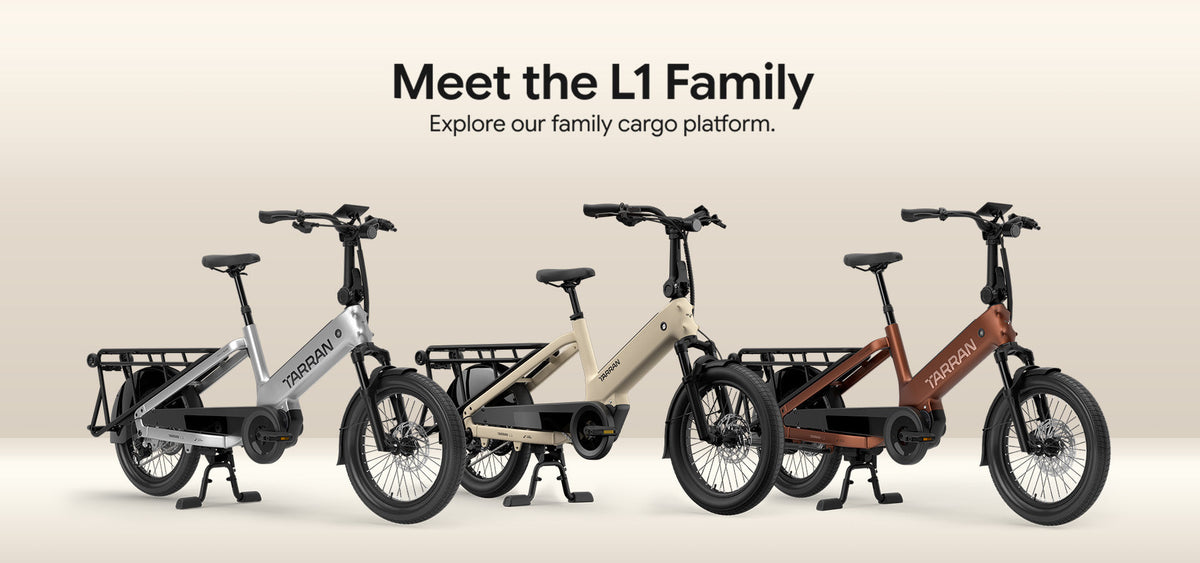
A useful family cargo bike has to answer those questions together. TARRAN's L1 Series Family Cargo Platform brings the carrying structure, passenger area, mounting interfaces, protection, and compatible accessories into one plan. It is shared across the L1h, L1m, and L1s. Drive and control systems vary by model. The family-carrying job described here is common to the series.
Family Cargo Changes What a Bike Needs to Be

Family trips combine needs that are easy to separate on a specification sheet. A child needs an age-appropriate place to ride. Their feet and hands need a suitable passenger setup. A school bag needs somewhere secure to go. Then the rider needs to start, turn, and stop with the complete load aboard.
The L1 Series Family Cargo Platform addresses that combined job through five connected parts: the frameset that carries the load, a rear area designed for passengers, interfaces for attaching seats and cargo, passenger-protection details, and compatible accessories that let the layout change. Each part matters more because the others are there. A strong rack has limited family value if bags displace the passenger; a comfortable seat is incomplete if there is no appropriate way to secure it.
Start with a Frame Built for the Load
The frameset is the part you cannot swap out when your routine changes. On the L1 Series, the cargo-oriented structure and extended rear rack provide the base for passengers, luggage, and the mounting points that connect them. The result is a longtail that can take on school-day duties without making the entire bicycle a single-purpose child carrier.
Three figures help explain the carrying envelope. The maximum gross weight is 215 kg for the stock bike. That total includes the bicycle, rider, passengers, accessories, and cargo. The rear rack is rated for up to 105 kg of rear load. An optional front rack is rated for up to 20 kg. The front and rear figures sit inside the overall gross-weight limit; adding them to 215 kg would overstate what the bike can carry.
Geometry for a More Composed Loaded Ride

Capacity tells you how much a bike is rated to carry. Geometry shapes how it behaves while carrying it. The L1 Series uses 20-inch wheels and a low-centre cargo layout to keep the passenger and carrying area relatively close to the ground. That design choice helps reduce the leverage of a high-mounted load when a rider rolls away, turns, or comes to a stop.
The low step-through frame addresses another repeated moment: getting on and off. On a school run, the rider may stop several times, steady the bike, help a child board, and start again. A lower standover makes those movements less awkward, especially when the rear is already occupied. It does not remove the need to hold the bike steady or help a child board according to the passenger instructions.
Steering geometry matters too. Front-wheel trail—the relationship between the steering axis and where the front tyre meets the ground—influences how readily the front wheel tracks and how the handlebar responds. TARRAN has tuned this geometry with loaded steering stability and manageable control in mind. The point for a rider is a bike designed to remain composed through ordinary family turns and small steering corrections, while still feeling practical to guide through city streets.
Make the Rear a Place for People
The rear rack is designed to become a passenger area when the trip calls for it. Its native MIK HD interface accepts compatible MIK HD child seats and accessories. Thule Yepp 2 is one example of the child-seat family TARRAN supports. The exact seat version and its mounting instructions still need to match the bike and the intended position.
Children at different stages need different arrangements. A younger child may need a compatible child seat with its own harness and age/weight rules. For a passenger who has moved beyond that stage, TARRAN's optional Kid Seat Cushion Set can provide a cushioned seating arrangement when used with the appropriate protection and foot support. The optional Passenger Seat Cushion Set is shaped for adult passengers. Cushions add comfort; they do not replace a child seat's restraint or any other required passenger equipment.
The optional openable GuardRail is designed to make the rear easier to enter and leave, while helping define the passenger space when fitted and secured. Optional foot support gives a seated passenger an appropriate place for their feet. Which pieces belong together depends on the passenger's age, size, the seat type, and the approved configuration. A rail, cushion, and child seat should never be treated as universally interchangeable parts of one layout.
Give the Bags Their Own Place
Children rarely travel alone. There are backpacks, coats, a lock, shopping, and whatever the afternoon adds. The L1 Series rear rack therefore has another important design detail: compatible third-party panniers can attach directly to its pannier mounting points. That includes Ortlieb examples, so a rider may be able to keep using bags already in their daily routine rather than replace every piece of luggage to make the bike useful.
For larger bag-based loads, the optional Pannier Expansion Mount adds another pair of mounting positions. With it, the rear rack can take two compatible panniers on each side, up to four in total. The expansion mount is a separate accessory. Four bags are a layout option, not four times the rack's load rating: their contents, the bags themselves, and anything else on the rear all count toward the 105 kg rear limit and the bike's 215 kg gross limit.
The top and sides of the rack answer different needs. MIK HD provides a connection for compatible top-mounted seats and accessories; the side mounting points give compatible panniers their place. An optional front rack can take up to 20 kg when a trip benefits from putting some belongings ahead of the rider. This lets a family think about where each item belongs, rather than treating the rear passenger space as the only available storage area.
What the Platform Has Been Tested For

The shared L1 Series platform has undergone mechanical-safety evaluation by TÜV Rheinland against relevant European EN 17860 and North American 16 CFR Part 1512 requirements. The reported scope includes dynamic frame tests for pedalling forces, horizontal forces, and vertical forces at the seat tube. It also includes fatigue, strength, frame-integrity, and fracture-resistance assessments. These tests examine how the structure responds to defined forces and repeated loading.
That evidence supports the design story behind the carrying platform. It has a clear boundary: a test has a specific specimen, procedure, and pass criteria. It does not predict every road surface, loading choice, or rider response, and it does not replace the stated passenger and accessory limits. For the family making a purchase decision, the useful combination is documented structural evaluation plus clear instructions for the setup they will actually ride.
Three Family Trips, Three Ways to Use the Same Platform
The school run: two children and their bags
Picture the morning routine. The children need approved places to ride; their backpacks should be secure without crowding the passenger area. The L1 Series can be configured for two child passengers, with the exact seats, cushions, protection, and foot support selected for their ages and sizes. Compatible panniers can give everyday bags a separate home, while an optional front rack is another place for suitable cargo.
After pickup: groceries join the trip
The passenger arrangement may stay in place after school, while the load changes. A few groceries can go into compatible panniers or onto an optional front rack, depending on the setup. The rack's side mounting points are particularly useful here: everyday bags need not take over the top of the rear platform simply because the rider has stopped at a shop. Check that the bags clear the passenger equipment and remain within the load limits.
Another day: a different passenger or no passenger
On a weekend, the rear may carry an older child or an adult with the appropriate optional passenger cushion and support. On a cargo-only ride, passenger accessories can be removed or left off to open the platform for the day's load. The same carrying foundation remains, while the equipment changes with the trip. Each passenger arrangement still needs its own approved accessories.
Choose the Setup Before You Choose the Extras

Start with the people. Who will ride on the rear most often, and what passenger equipment is appropriate for each person's age, size, and weight? Check the current bike and accessory instructions before choosing a child seat, Kid Seat Cushion Set, or Passenger Seat Cushion Set. Add the protection and foot support required for that approved arrangement.
Before riding, check the numbers and the actual setup. Keep the complete bike, rider, passengers, accessories, and cargo within the 215 kg gross limit, the rear load within 105 kg, and any optional front-rack load within 20 kg. Confirm secure attachment, passenger instructions, and local rules. After changing the setup, a short, low-speed check in a safe place helps the rider get familiar with how the bike now steers, stops, and balances.
Frequently Asked Questions
Can I carry two children and their everyday bags on one trip?
The L1 Series is intended to support that family scenario. Use an approved passenger arrangement for each child's age and size, and give bags suitable positions such as compatible panniers or an optional front rack. The exact mix of seats, cushions, protection, foot support, and bags must follow the current installation guidance and load limits.
Which MIK HD child seats can I use?
The rear rack has a native MIK HD interface for compatible child seats and accessories. Thule Yepp 2 is an example, but the seat's precise version, mounting hardware, position, and passenger limits matter. Check the current compatibility information and both installation manuals before buying or moving a seat between bikes.
Can I use my existing Ortlieb panniers? How do I fit four bags?
The rear rack accepts compatible third-party panniers, including Ortlieb examples, directly on its side mounting points. The optional Pannier Expansion Mount adds positions for a second bag on each side, allowing up to four compatible panniers in total. Confirm your bags' specific attachment system and their clearance with seats, rails, and foot support. Four positions do not increase the 105 kg rear load limit.
How do the 215 kg, 105 kg, and 20 kg limits work together?
The 215 kg figure is the maximum gross weight of the stock bike with everything and everyone aboard. The rear rack can carry up to 105 kg of that total. If fitted, the optional front rack can carry up to 20 kg, also within the gross total. Count the weight of the rack-mounted accessories and bags as well as their contents.
Are the GuardRail, cushions, foot support, pannier mount, and front rack included?
They are optional accessories. What is offered in a particular bundle or promotion can change, so check the current order configuration for the specific bike and market. Do not assume that an accessory shown in a photograph is included with every L1 Series bike.
What changes when an older child or adult rides on the rear?
The passenger setup should change with them. Use equipment intended for that passenger, including the appropriate cushion, support, and protection where required. Confirm passenger and rear-rack weight limits, installation, and local passenger rules. A child seat and its harness should be used only within the child seat's own instructions.
Built Around the Trips That Repeat
A school run, a grocery stop, and a cargo-only ride ask different things of the same bike. The L1 Series Family Cargo Platform is designed around those changes. Its frameset, geometry, passenger area, mounting points, protection, and optional accessories give a household a way to build the arrangement that fits the trip. The details worth checking are the practical ones: who is riding, what is attached, where the weight goes, and whether that precise setup is approved.
For the latest accessory fit and passenger instructions, review the current L1 Series product and accessory information before configuring your bike.


Efterlad en kommentar
Denne side er beskyttet af hCaptcha, og hCaptchas Politik om beskyttelse af persondata og Servicevilkår er gældende.